


Basketball courts · Construction
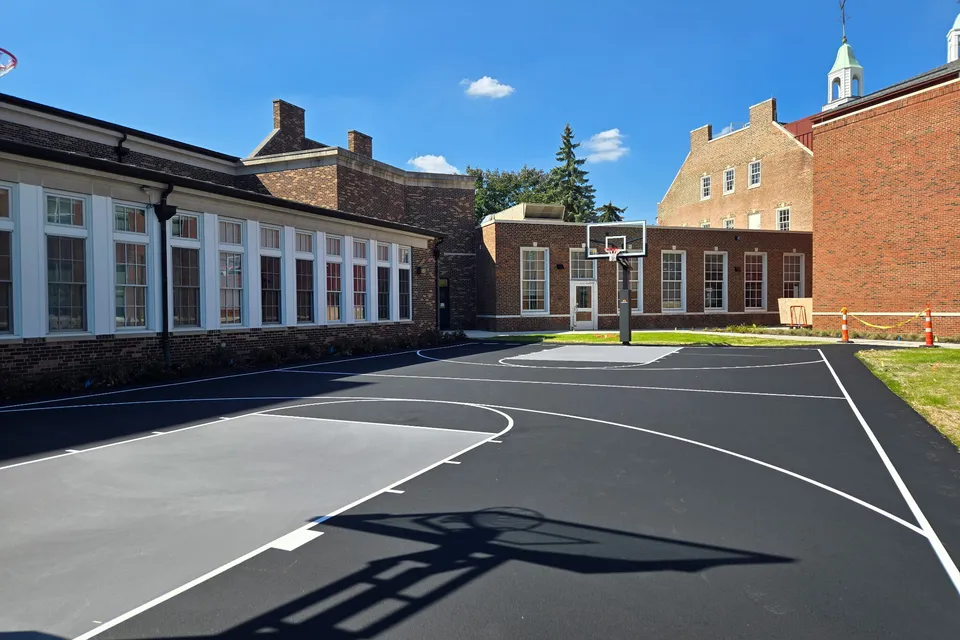
New outdoor basketball court construction.
Full courts and half courts for parks, schools and homes: the pad, the base, the color system, the lines, the goals.
What is included
The job, in order.
-
01
Size and site
Full court or half, high school or college dimensions, which way it faces and where the run-off goes. Three feet outside the lines is the minimum; ten where a fence or wall is close.
-
02
Base
Excavation, compacted subgrade, six to eight inches of crushed limestone and two lifts of asphalt to a 1 percent plane, or a concrete slab. The slope goes away from the goals' end where it can.
-
03
Goal footings
Poured before the pad is paved, sized for the pole and the wind off the lake, with the overhang set so the backboard plane lands on the baseline.
-
04
Cure
New asphalt rests 20 to 25 days before coating; concrete cures and is etched or primed first.
-
05
Color system
SportMaster acrylic resurfacer, two color coats with sand: a court color, an apron color, often a third in the keys.
-
06
Lines
Keys, free-throw lines and circles, the three-point arc of choice and the center circle, laid out by hand and painted in two coats of textured line paint.
-
07
Goals, fence, extras
Goals hung and set plumb, rims at 10 feet; fence or ball-stop netting where the site needs it; benches, a bike rack, lighting on a timer.
What goes on
Materials, and why.
- In-ground goal systems
- Steel poles in concrete, 4 or 5 foot overhang, breakaway rims, acrylic or glass backboards for outdoor use.
- SportMaster ColorPlus
- The color coats; the sand load for basketball is a touch finer than for tennis so the ball does not skid.
- Crushed limestone and asphalt
- The base: stone in compacted lifts, binder and surface courses of asphalt.
What it costs
A new full court with base, coating, lines and two in-ground goals is priced by the site as much as the court: access, soil, drainage and lighting move the figure. A half court on an existing sound pad is a modest job.
Questions
About construction.
Also under basketball courts:
- Resurfacing · A park court worn to the black under the rims brought back: repaired, leveled, coated in a fresh color scheme, relined to the rulebook.
- Repair & leveling · Cracks bridged, the hollows under the rims leveled, lifted edges cut out, leaning goals reset.
- Line striping · Keys, free-throw circles, the three-point arc of your choice and the center circle, laid out by hand and painted to last.
How big is a half court?
A regulation half court is 47 by 50 feet (college) or 42 by 50 (high school). A playground half court is often 30 by 30 to 40 by 50, which still fits a key and an arc. The dimensions page has the diagram.
Can a basketball court double as pickleball?
Yes: one or two pickleball courts across the half courts in a fourth color, with portable nets. Mornings for pickleball, evenings for basketball. See multi-sport courts.
Reading
From the articles.
Bringing an outdoor basketball court back
Worn to black under the rim, cracks across the key, a goal that leans: the restoration, step by step.
Read onBuilding a new court: what happens before the first load of stone
The slab is the court. Soil tests, swales, stone, the plate compactor and the laser: the month before color.
Read onLED court lighting: what changed and what to specify
Fewer poles, less spill, timers the neighbors like. The numbers to put in a lighting spec.
Read onFree estimates
Get a number you can plan around.
Send the address and what you have in mind. We walk the site, measure it, and send a written proposal with the scope spelled out: what gets done, what it costs, and when it fits the season.
The yard
4000 East 86th Street, Cleveland, OH 44105
Off Broadway Avenue, south of downtown, ten minutes from I-77 and I-490.
Serving Cuyahoga, Summit, Lake, Lorain, Medina, Geauga, Portage, Stark and Ashtabula counties. Municipal, school, club, HOA and commercial work; residential courts by the job.