


Parking lots · Sealcoating
Parking lot sealcoating.
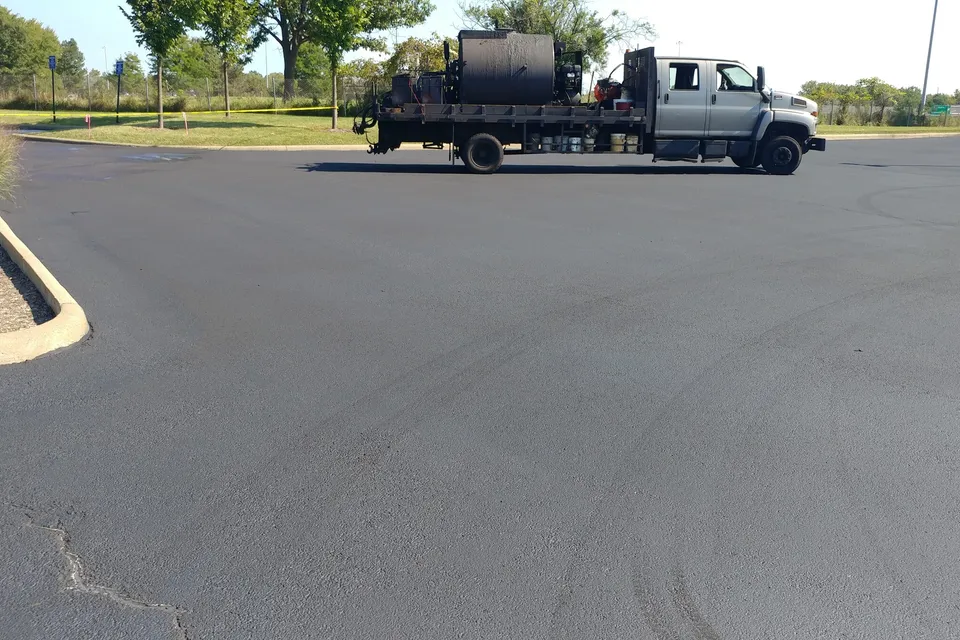
Two coats of sealer with sand over a cleaned, crack-filled lot, in sections, with fresh lines on top and the lot open by morning.
What is included
The job, in order.
-
01
Inspection
We walk the lot and mark what sealer will protect and what it will not: cracks to fill, alligatored areas to patch, potholes to cut out, drains to check. You get the map with the quote.
-
02
Cleaning
Power-broomed and blown clean, oil spots scraped and primed; sealer bonds to clean asphalt and to nothing else.
-
03
Crack filling
Cracks a quarter inch and wider cleaned with heat and air and filled with hot-pour rubberized sealant, flush with the surface.
-
04
Patching
Potholes and failed areas cut out, compacted and patched with hot mix; alligatored areas where the base is sound skin-patched or infrared-repaired.
-
05
First coat
Sealer with sand, applied by squeegee machine or spray at the maker's rate, cut in by hand at curbs and buildings.
-
06
Second coat
Applied crosswise once the first has dried, for an even film with no squeegee marks; a third coat on the drive lanes where the traffic is.
-
07
Striping
Stalls, arrows, fire lanes, accessible stalls and aisles laid out and painted as soon as the sealer takes a line.
-
08
Reopening
Cones and barricades off the next morning; a note in your file of the year the next seal is due.
When you need it
The signs.
- Asphalt gone from black to gray
- Fine cracking in the surface, especially on the sun side
- Loose stone on the surface after rain
- Lines faded past seeing at night
- A lot sealed more than four years ago, or a new lot more than a year old
What goes on
Materials, and why.
- Refined coal-tar sealer
- The traditional product: hardest-wearing, resistant to fuel and oil drips, with a distinct smell while curing.
- Asphalt-emulsion sealer
- Lower odor, no coal tar, required by some owners and districts; polymer-modified grades close most of the wear gap.
- Silica sand
- Mixed into the sealer for traction and wear; the rate is set by the maker and the traffic.
- Hot-pour rubberized crack sealant
- Melted and poured into cleaned cracks; stays flexible through winter.
- Waterborne traffic paint
- Low-VOC acrylic stall paint in white, yellow and blue; glass beads where night visibility matters.
What it costs
Sealcoating is priced by the square foot, falling as the lot grows, with crack filling by the foot and patching by the area on top. The walk turns that into a number.
Questions
About sealcoating.
Also under parking lots:
- Crack filling · Cracks cleaned, heated and filled with hot-pour rubber before the water and the winter get into them.
- Line striping & ADA · Stalls, arrows, fire lanes and the accessible stalls, aisles and signs the 2010 ADA Standards require, laid out to a plan and painted to last.
- Patching & construction · Potholes patched, failed areas cut out and repaved, worn lots milled and overlaid, and new lots built with the base and drainage that decide how long they last.
When can cars come back?
The next morning in normal weather: 24 hours is the rule for cars and longer for trucks. Hot, humid, still days need more; we tell you before we start.
Why two coats?
One coat leaves squeegee marks and thin spots; the second, crosswise, evens the film and doubles the life. A third on the drive lanes, where every car turns, is money well spent. A contractor quoting one coat is quoting half the job.
Does sealing a lot add years?
Kept on a two-to-four-year cycle with the cracks filled, a lot that would need paving at twelve to fifteen years lasts twenty-five or more. The arithmetic article works it through.
Reading
From the articles.
What skipping one sealcoat cycle really costs a parking lot
Seal it on a cycle, or pave it later for many times the money. The years in between, in round units.
Read onSealcoat or resurface: which your lot actually needs
Sealer protects asphalt; it does not repair it. The signs that say which stage a lot is at, and what each costs.
Read onFill the cracks before the first freeze
The cheapest hour of maintenance all year is the one spent filling cracks in October.
Read onFree estimates
Get a number you can plan around.
Send the address and what you have in mind. We walk the site, measure it, and send a written proposal with the scope spelled out: what gets done, what it costs, and when it fits the season.
The yard
4000 East 86th Street, Cleveland, OH 44105
Off Broadway Avenue, south of downtown, ten minutes from I-77 and I-490.
Serving Cuyahoga, Summit, Lake, Lorain, Medina, Geauga, Portage, Stark and Ashtabula counties. Municipal, school, club, HOA and commercial work; residential courts by the job.