

Parking lots · Line striping & ADA
Parking lot line striping and ADA layout.
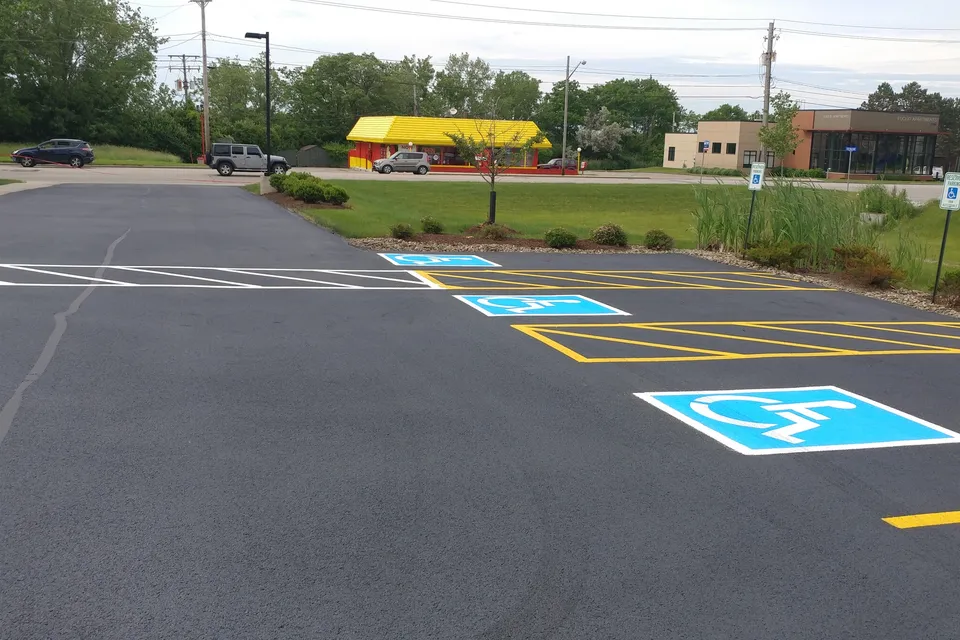
Stalls, arrows, fire lanes and the accessible stalls, aisles and signs the 2010 ADA Standards require, laid out to a plan and painted to last.
What is included
The job, in order.
-
01
Layout plan
Stall count and size, drive-aisle widths, the accessible stalls and van space the ADA table requires for the lot's size, fire lanes, loading zones and crosswalks, drawn before paint.
-
02
Accessible stalls
Placed on the shortest accessible route to the entrance, 8 feet wide with a 5-foot aisle (van stalls 11 feet with a 5-foot aisle, or 8 with an 8), on ground no steeper than 1:48 in any direction, with a sign at 60 inches.
-
03
Marking
Lines snapped or laid out with a striping machine from control lines; arcs and symbols stencilled.
-
04
Paint
Waterborne traffic paint, 4-inch lines, two coats on new asphalt or sealer, with glass beads where the lot is used at night.
-
05
Signs and stops
ADA signs, fire-lane signs, curb stops and bollards installed or reset.
When you need it
The signs.
- Lines faded past seeing in the rain
- A lot that was resealed and never restriped properly
- No van-accessible stall, or accessible stalls on a slope
- A fire lane the fire department has mentioned
- A lot being reconfigured for more stalls or an EV charger
What goes on
Materials, and why.
- Waterborne acrylic traffic paint
- Fast-drying, in white, yellow, blue and red, under the 100 grams-per-liter VOC limit Ohio has set for traffic paint since 2024.
- Glass beads
- Dropped into wet paint for retroreflectivity at night.
- ADA signage
- The International Symbol of Accessibility and "van accessible" signs, mounted at 60 inches to the bottom edge.
What it costs
Striping is priced per stall with extras for symbols, arrows, fire lanes and signs; included with a sealcoat.
Questions
About line striping & ada.
Also under parking lots:
- Sealcoating · Two coats of sealer with sand over a cleaned, crack-filled lot, in sections, with fresh lines on top and the lot open by morning.
- Crack filling · Cracks cleaned, heated and filled with hot-pour rubber before the water and the winter get into them.
- Patching & construction · Potholes patched, failed areas cut out and repaved, worn lots milled and overlaid, and new lots built with the base and drainage that decide how long they last.
How many accessible stalls does my lot need?
One for a lot of 1 to 25 stalls, two for 26 to 50, three for 51 to 75, four for 76 to 100, and so on up the ADA table; one in six of them (and at least one) must be van-accessible. The ADA article has the whole table and the four mistakes we see most.
Can you restripe without sealing?
Yes. On a lot that is not due for sealing, old lines are blacked out where the layout changes and the new lines go on over the old. It takes a day and the lot stays open in sections.
What width are stalls?
Nine feet is standard for public lots in Ohio; eight and a half where a landlord needs the count and the cars are small; ten for a grocery lot where doors open wide. Drive aisles 24 feet for two-way, 90-degree parking.
Reading
From the articles.
ADA parking: the layout rules every lot has to meet
The count table, the van space, the 1:48 slope, the sign height: the rules, and the four mistakes on most lots.
Read onCracked courts and liability: what a facility manager should know
A lifted edge is a trip hazard with a date on it. Inspections, records and repairs that keep an owner on the right side of a claim.
Read onFree estimates
Get a number you can plan around.
Send the address and what you have in mind. We walk the site, measure it, and send a written proposal with the scope spelled out: what gets done, what it costs, and when it fits the season.
The yard
4000 East 86th Street, Cleveland, OH 44105
Off Broadway Avenue, south of downtown, ten minutes from I-77 and I-490.
Serving Cuyahoga, Summit, Lake, Lorain, Medina, Geauga, Portage, Stark and Ashtabula counties. Municipal, school, club, HOA and commercial work; residential courts by the job.