


Parking lots · Crack filling
Parking lot crack filling.
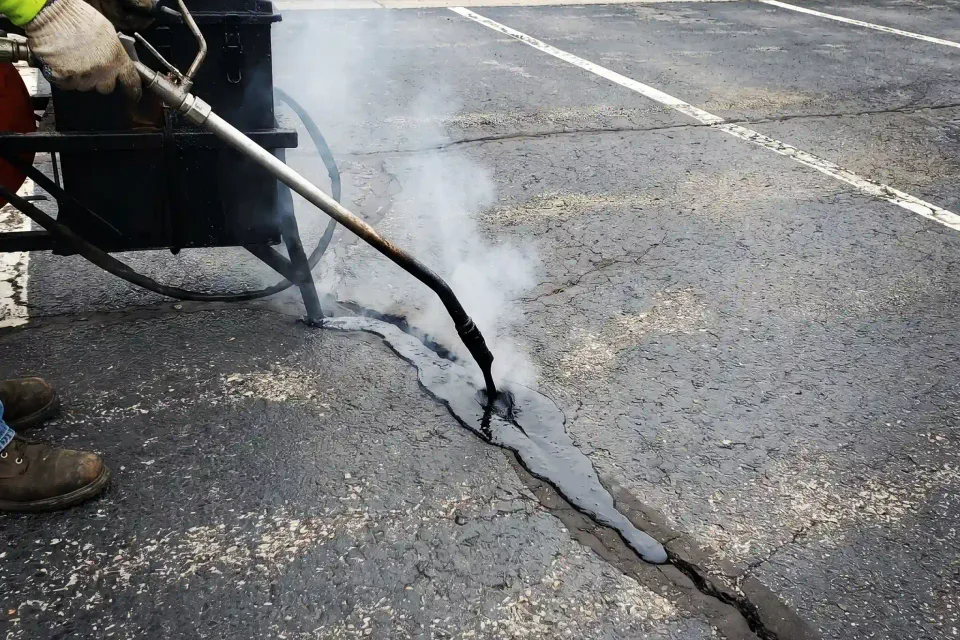
Cracks cleaned, heated and filled with hot-pour rubber before the water and the winter get into them. The cheapest hour of maintenance a lot gets all year.
What is included
The job, in order.
-
01
Mapping
Cracks walked and measured; the ones a quarter inch and wider are the job, the hairlines are watched.
-
02
Cleaning
Each crack blown out and dried with a hot-air lance so the sealant bonds to clean, dry asphalt.
-
03
Routing
Where a specification asks for it, cracks are routed to a uniform reservoir so the sealant has the right shape to flex.
-
04
Hot-pour
Rubberized sealant melted in a kettle to the maker's temperature and poured flush, or overbanded in a thin strip across the crack on drive lanes.
-
05
Sand or paper
Dusted so tires do not pick it up before it cools; traffic back within the hour.
When you need it
The signs.
- Any crack you can fit a coin in
- Cracks that drained water last spring
- Grass growing in the cracks
- A lot due for sealing (crack filling comes first)
- October, in any year
What goes on
Materials, and why.
- Hot-pour rubberized crack sealant
- A polymer-modified asphalt that stays flexible to below zero; melted on site.
- Cold-pour crack filler
- For small jobs and a few cracks: pourable, no kettle, less durable.
What it costs
Priced by the linear foot, with a minimum for the kettle and the crew. On most lots an autumn crack-fill is the best return on the maintenance budget.
Questions
About crack filling.
Also under parking lots:
- Sealcoating · Two coats of sealer with sand over a cleaned, crack-filled lot, in sections, with fresh lines on top and the lot open by morning.
- Line striping & ADA · Stalls, arrows, fire lanes and the accessible stalls, aisles and signs the 2010 ADA Standards require, laid out to a plan and painted to last.
- Patching & construction · Potholes patched, failed areas cut out and repaved, worn lots milled and overlaid, and new lots built with the base and drainage that decide how long they last.
Why every autumn?
Because a crack filled in October keeps the water out through forty freeze-thaw cycles; one left open becomes two cracks by March and a pothole the year after. The October article is the whole case.
What about alligator cracking?
That is not a crack-filling job: an area cracked into a pattern has lost its base and needs patching or replacement. Filling each crack in an alligatored area is a waste of sealant, and we say so on the walk.
Can you fill cracks on a court the same way?
No; courts get acrylic fillers and a fabric-membrane system because hot-pour sealant shows through color coats and softens in the sun. See court crack repair.
Reading
From the articles.
Fill the cracks before the first freeze
The cheapest hour of maintenance all year is the one spent filling cracks in October.
Read onWhat a Northeast Ohio winter does to a court
Water gets in, freezes, pushes, thaws, and does it forty more times by March. How the damage happens and how to blunt it.
Read onWhat skipping one sealcoat cycle really costs a parking lot
Seal it on a cycle, or pave it later for many times the money. The years in between, in round units.
Read onFree estimates
Get a number you can plan around.
Send the address and what you have in mind. We walk the site, measure it, and send a written proposal with the scope spelled out: what gets done, what it costs, and when it fits the season.
The yard
4000 East 86th Street, Cleveland, OH 44105
Off Broadway Avenue, south of downtown, ten minutes from I-77 and I-490.
Serving Cuyahoga, Summit, Lake, Lorain, Medina, Geauga, Portage, Stark and Ashtabula counties. Municipal, school, club, HOA and commercial work; residential courts by the job.