


Basketball courts · construction, resurfacing, repair, lines
Outdoor basketball courts built, resurfaced and lined.
Park courts, school courts, half courts and full courts: a flat, drained base, a SportMaster acrylic color system that takes a decade of pickup games, keys and arcs laid out to the rulebook, and goals set plumb on footings sized for the wind.
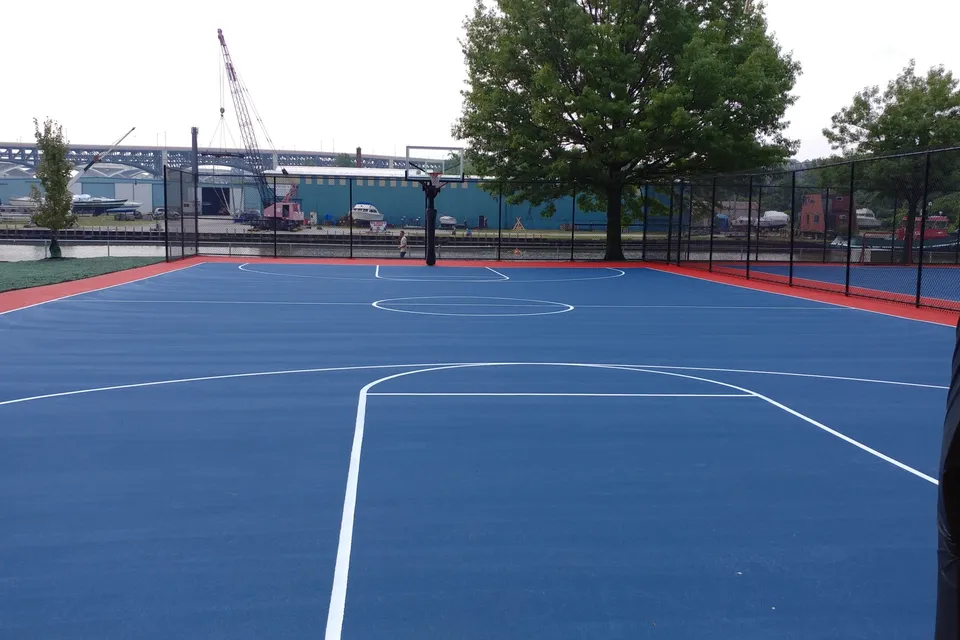
An outdoor basketball court takes more abuse per square foot than any other court: ten players, hard stops under the rim, bikes across it on the way home, and the same freeze-thaw winters as everything else in Northeast Ohio. It is built the same way as a tennis court, a flat base at a 1 percent plane with an acrylic color system on top, and it is lined to a rulebook that changed in 2019 for college and keeps three different three-point arcs in play.
Most of our basketball work is for cities, park districts and schools: a worn park court resurfaced in a new color scheme, a new full court in a new park, a half court added where a pad already exists. We build to the high school court (84 by 50) or the college and NBA court (94 by 50), with the key and the arc the owner asks for, and we set the goals ourselves, plumb, on footings that will not lean.
The color system is SportMaster ColorPlus, which is what is on the courts in the photographs. Two colors are usual, a darker court and a lighter apron, and the keys are often a third. Pickleball lines can be blended on in a fourth, which is how a park court earns its keep in the mornings.
The work
Basketball courts: four jobs, one crew.
Each has its own page with what is included, when you need it, what goes on and what it costs.
Construction
Full courts and half courts for parks, schools and homes: the pad, the base, the color system, the lines, the goals.
The detailsResurfacing
A park court worn to the black under the rims brought back: repaired, leveled, coated in a fresh color scheme, relined to the rulebook.
The detailsRepair & leveling
Cracks bridged, the hollows under the rims leveled, lifted edges cut out, leaning goals reset.
The detailsLine striping
Keys, free-throw circles, the three-point arc of your choice and the center circle, laid out by hand and painted to last.
The detailsProjects
Basketball work you can go and see.
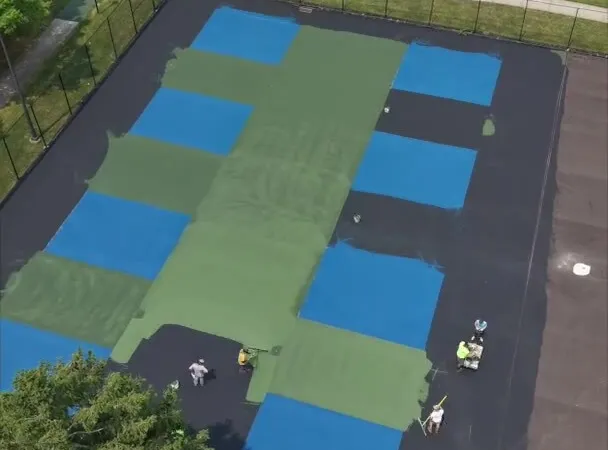
Parma Heights: three tennis and seven pickleball courts at Greenbrier Commons
A city's whole court complex rebuilt in one season, bought through the SportMaster cooperative contract without a separate bid. The biggest job on the public record.
The project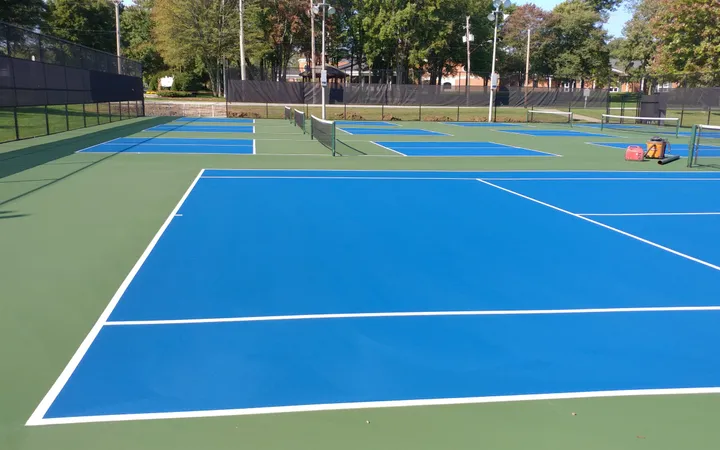
Independence: the Selig Drive tennis and pickleball courts
Tennis and pickleball side by side under one color system, a park the city keeps in good order.
The project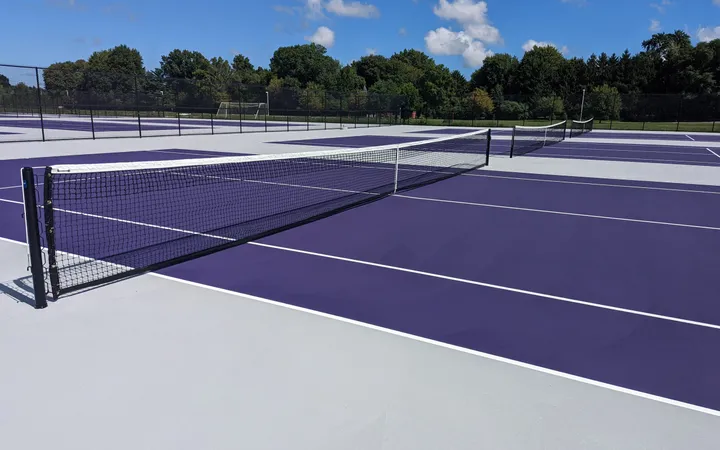
Avon High School: eight tennis and five pickleball courts in purple and gray
School colors on the playing area, a cool gray outside the lines so the courts do not cook in July.
The projectQuestions
About basketball courts.
More on the questions page; the long answers are in the articles below.
Which three-point line should a park court have?
The high school arc (19 feet 9 inches) is what most park and school courts use, because most of the players are of that age and that is the game they play in the gym. A court for an older crowd sometimes gets the college arc. Painting two arcs is possible and usually a mistake; pick one.
Asphalt or concrete?
Asphalt over stone, coated with acrylic, is the standard for outdoor courts here and what the photographs show. A concrete slab works and costs more; it has to be coated too, because bare concrete is slick when wet and hard on knees. Either way the slab must be on one plane with a 1 percent fall.
Can you fix the goals too?
Yes. We set in-ground goals in concrete footings sized for the pole and the wind, replace bent rims and cracked backboards, and remove old poles. A goal that leans is the first thing a player notices and the last thing most contractors fix.
How long does a resurfaced court last?
Four to eight years to the next surface, like a tennis court, with the zones under the rims wearing first. Autumn crack filling and a wash a year stretch it. The base, built right, lasts decades.
Reading
From the articles.
Bringing an outdoor basketball court back
Worn to black under the rim, cracks across the key, a goal that leans: the restoration, step by step.
Read onWhy court cracks come back, and what actually stops them
A filled crack is a sealed crack, not a fixed one. Freeze-thaw, base movement, and the repairs that hold.
Read onBlended lines: two sports on one court without confusing anyone
A second sport in a second color, two shades apart. The combinations that play well and the ones that do not.
Read onFree estimates
Get a number you can plan around.
Send the address and what you have in mind. We walk the site, measure it, and send a written proposal with the scope spelled out: what gets done, what it costs, and when it fits the season.
The yard
4000 East 86th Street, Cleveland, OH 44105
Off Broadway Avenue, south of downtown, ten minutes from I-77 and I-490.
Serving Cuyahoga, Summit, Lake, Lorain, Medina, Geauga, Portage, Stark and Ashtabula counties. Municipal, school, club, HOA and commercial work; residential courts by the job.