


Parking lots · sealcoating, crack filling, striping, construction
Parking lots sealed, crack-filled, striped and kept.
Sealcoating on a schedule, crack filling every autumn, lines and ADA stalls laid out to the standard, patching where the plow got it, and new lots where the old one is past saving. For businesses, churches, schools, HOAs and property managers across Northeast Ohio.
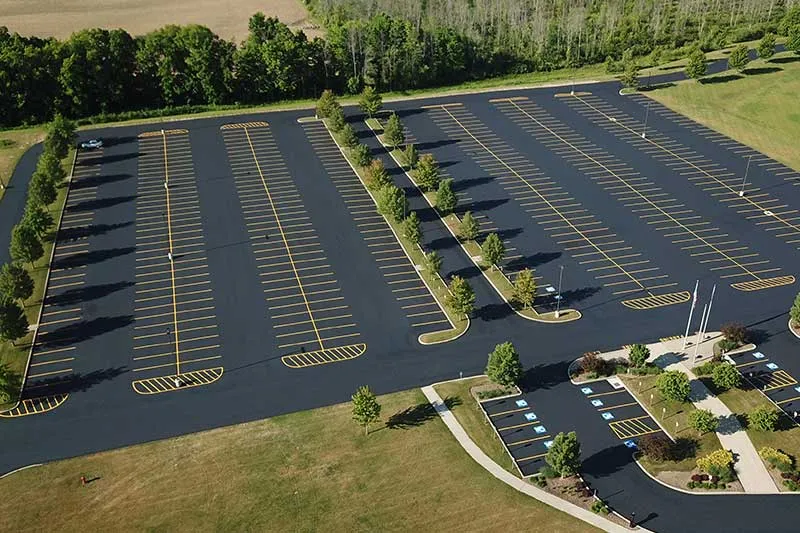
Asphalt fails from the top down and the edges in. Sun oxidizes the binder and the surface goes gray and brittle; water gets into the first cracks and the winter opens them; the cracks join up into alligator patterns, the alligator patterns become potholes, and a lot that could have been sealed for a dollar or two a square yard needs a new lift of asphalt at many times that. The whole trade of pavement maintenance is catching a lot at the first stage and keeping it there.
Our program is the one we run on our own yard. A new lot gets its first sealcoat about a year after paving. After that: cracks filled with hot-pour rubber every autumn, two coats of sealer with sand every two to four years, fresh lines with each seal, and the plow driver told where the curb stops are. In our experience a lot kept that way lasts twenty-five years or more, and one that is not is a paving job at twelve.
We stripe to the 2010 ADA Standards for Accessible Design, which are specific about how many accessible stalls a lot needs, how wide the access aisles are, how flat the stalls must be and where the signs go, and we mark fire lanes the way the local fire department wants them. Lots are sealed in sections so there is always parking, and reopened the next morning.
The work
Parking lots: four jobs, one crew.
Each has its own page with what is included, when you need it, what goes on and what it costs.
Sealcoating
Two coats of sealer with sand over a cleaned, crack-filled lot, in sections, with fresh lines on top and the lot open by morning.
The detailsCrack filling
Cracks cleaned, heated and filled with hot-pour rubber before the water and the winter get into them. The cheapest hour of maintenance a lot gets all year.
The detailsLine striping & ADA
Stalls, arrows, fire lanes and the accessible stalls, aisles and signs the 2010 ADA Standards require, laid out to a plan and painted to last.
The detailsPatching & construction
Potholes patched, failed areas cut out and repaved, worn lots milled and overlaid, and new lots built with the base and drainage that decide how long they last.
The detailsProjects
Parking lot work you can go and see.
Questions
About parking lots.
More on the questions page; the long answers are in the articles below.
How often should a lot be sealcoated?
Every two to four years, with the cracks filled every autumn. The sun side of a building and the drive lanes wear fastest. Sealing more often than every two years wastes money and builds up a skin that peels; waiting past four lets the oxidation and the water get ahead.
How long is the lot closed?
One day per section, reopened the next morning. We phase a busy lot so there is always parking, do the fire lanes and accessible stalls first when striping, and keep trucks off the fresh sealer for 24 hours.
Coal tar or asphalt emulsion?
Refined coal-tar sealer is the traditional product and the longest-wearing. Asphalt-emulsion sealers have less odor and are required by a growing number of owners, school districts and a few jurisdictions; Ohio has no state ban but a specification may ask for one or the other. We carry both and explain the trade-off; the sealcoat or resurface article has more.
Will sealcoating fix the cracks and potholes?
No. Sealer protects asphalt; it does not repair it. Cracks are filled first, potholes and alligatored areas are patched or cut out and repaved, and then the lot is sealed. A contractor who seals over failed asphalt is selling you a coat of black paint.
Reading
From the articles.
What skipping one sealcoat cycle really costs a parking lot
Seal it on a cycle, or pave it later for many times the money. The years in between, in round units.
Read onSealcoat or resurface: which your lot actually needs
Sealer protects asphalt; it does not repair it. The signs that say which stage a lot is at, and what each costs.
Read onADA parking: the layout rules every lot has to meet
The count table, the van space, the 1:48 slope, the sign height: the rules, and the four mistakes on most lots.
Read onFree estimates
Get a number you can plan around.
Send the address and what you have in mind. We walk the site, measure it, and send a written proposal with the scope spelled out: what gets done, what it costs, and when it fits the season.
The yard
4000 East 86th Street, Cleveland, OH 44105
Off Broadway Avenue, south of downtown, ten minutes from I-77 and I-490.
Serving Cuyahoga, Summit, Lake, Lorain, Medina, Geauga, Portage, Stark and Ashtabula counties. Municipal, school, club, HOA and commercial work; residential courts by the job.