


Guide
How a job goes, from the call to the lines.
No mystery in it. Nine steps, each with its own weather and its own drying time, in an order that does not change. Here is what happens and when.
- Step 01
The call
Tell us what you have: how many courts or how big the lot, what you are seeing, and when you would like it done. If there is a bid package, send it. If there are photos, send those too; half the questions answer themselves.
- Step 02
The site walk
We come out, usually within the week in the off-season and within two in summer. We measure, check the plane with a level, map the cracks, look at the base through any open joint, and, if there has been rain, see where the water sits. It takes an hour and it is free.
- Step 03
The written proposal
Scope, materials by name, color options, the price, and the alternative where there is one: repair now and resurface in two years, or resurface now and skip the repair. The number on the proposal is the number on the invoice unless the scope changes.
- Step 04
The date
Coatings and sealers need warm, dry weather, so the season runs roughly May to mid October and every job in it has a week. We tell you where yours sits, and we call the day before the crew comes. Rain moves things; it never shortens them.
- Step 05
Preparation
The surface is pressure-washed, scraped where there is loose material, and treated where there is algae. Low spots are flooded, marked and leveled with patch binder. Cracks are cleaned, routed where needed, and repaired, hot-pour for lots and a fabric-membrane system for courts.
- Step 06
Base and resurfacer
On a new court, the stone and asphalt base cures for 20 to 25 days before any coating. On any court, an acrylic resurfacer goes on with squeegees to fill the texture and give the color a uniform ground. It dries in a few hours in good weather.
- Step 07
Color
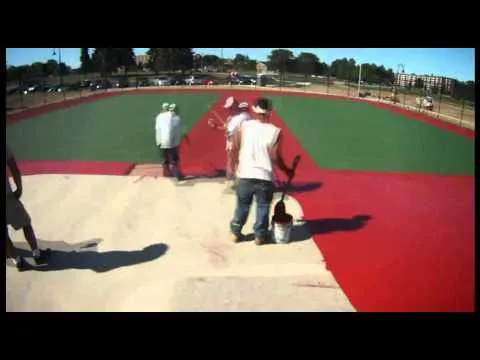
Two coats of SportMaster ColorPlus with silica sand in them for texture, applied at 50 °F and rising on a dry surface, with a few hours between coats and no rain in sight. The second coat goes on at ninety degrees to the first so the texture is even.
- Step 08
Lines
Laid out from the net line by tape and square to the USTA or USA Pickleball diagram, checked twice, then hand taped and hand painted in two coats of textured line paint. Lines go on the day after the color, once it has cured enough to take tape.
- Step 09
Hand over
Nets hung and set to height, posts plumb, cones gone, the court swept, and a one-page maintenance sheet in your hand with the year the next look is due. Play can start 24 to 48 hours after the lines, depending on the weather.
Why the waiting
Every coat has a clock.
Acrylic coatings cure by losing water. They need the surface above 50 °F, the air above 50 °F and rising, humidity that lets the water leave, and a night that does not drop near freezing before the coat has set. Rush a coat and it peels next spring; apply one over damp resurfacer and it blisters. The schedule on a court is mostly the weather's, and the crew's job is to be ready the hour it allows.
Sealcoat is the same story on a lot: two thin coats with sand, each one dry before the next, and traffic kept off until the morning. The contractor who finishes in a day is not faster; he is skipping a coat.
Questions
About the work itself.
The season page has the calendar.
How long will my court be out of use?
About a week for one court, with the court closed from the first wash to the day after the lines. Multi-court banks are done in phases so some courts stay open; see the article on phasing a facility.
What if it rains?
We stop, and the job picks up when the surface is dry again. Rain on a wet coat is the one thing that can ruin a day's work, so we watch the radar and do not start a coat we cannot finish. A rainy week adds days; it never changes what gets done.
Do I need to be there?
For the site walk, yes, or someone who knows the history of the court. For the work, no. We need access, water for washing, and somewhere to park the trucks.
What do you need from a school district or a city?
The purchase order or the signed contract, the certificate of insurance on file, a contact who can open gates, and, on public jobs, the prevailing-wage schedule if one applies. We have done this for decades; the paperwork is routine.
Free estimates
Start with the walk.
Call (216) 341-2662 or send the address. An hour on site and a written proposal, and you know where you stand.
The yard
4000 East 86th Street, Cleveland, OH 44105
Off Broadway Avenue, south of downtown, ten minutes from I-77 and I-490.
Serving Cuyahoga, Summit, Lake, Lorain, Medina, Geauga, Portage, Stark and Ashtabula counties. Municipal, school, club, HOA and commercial work; residential courts by the job.