

Guide
Court colors, and what they do besides look good.
Color is the decision owners enjoy most and the one with the most hidden consequences: surface temperature, glare, ball visibility, how dirt shows, how lines read at dusk. Here is the chip we work from and the pairings we recommend.
The range
SportMaster ColorPlus, the standard colors.
Seventeen colors, any two of which can be a court. The figure is the solar reflectance index where the maker prints one; higher is cooler, and 29 or more earns a LEED heat-island credit.
Dark Green
standard
Light Green
SRI 31
Forest Green
standard
Blue
standard
Beige
standard
Red
SRI 36
Light Blue
standard
Sandstone
SRI 46
Tournament Purple
higher-cost pigment
Maroon
standard
Gray
standard
Ice Blue
SRI 62
Dove Gray
SRI 33
Orange
higher-cost pigment; may need extra coats
Yellow
standard
Brite Red
SRI 62
Black
standard
Swatches are approximations on a screen; the printed chip and a sample on the court are the truth. ColorPlus Fusion adds more than a hundred blends.
Pairings
The combinations we recommend.
Dark where the game is, lighter where the players stand, and lines the eye can find at eight in the evening.
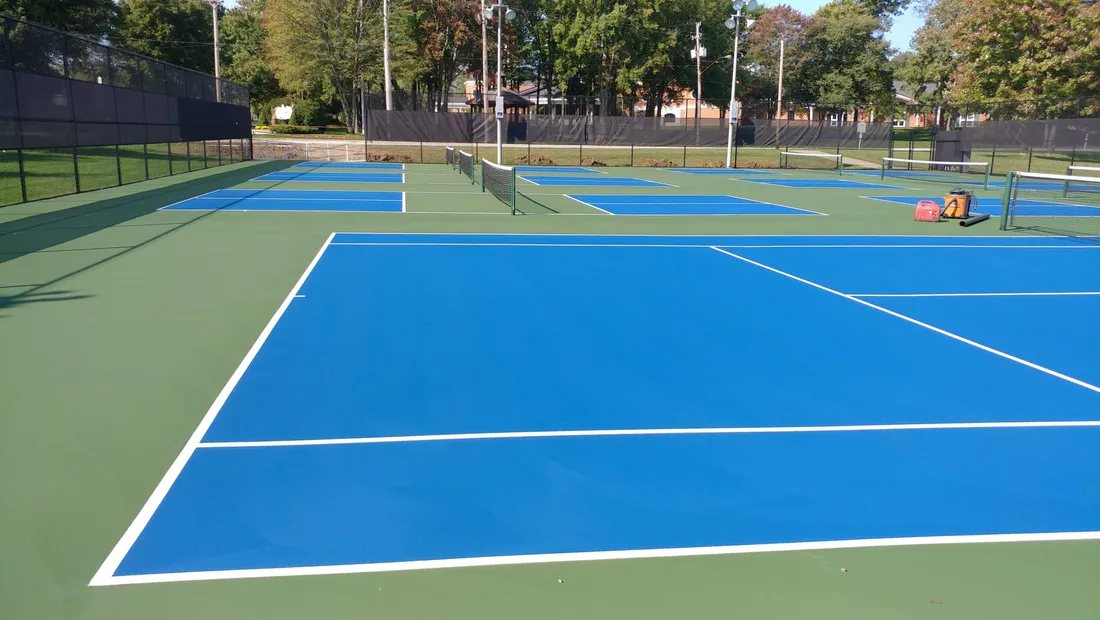
Blue court, green surround
The US Open pairing and the most popular in the region: the ball shows well on blue, the green stays cooler and hides dirt. Independence and most of our park work.
Dark green court, light green surround
The traditional club look. Easy on the eye, forgiving of leaves and shade, and the light green earns a reflectance credit.
School color inside, gray outside
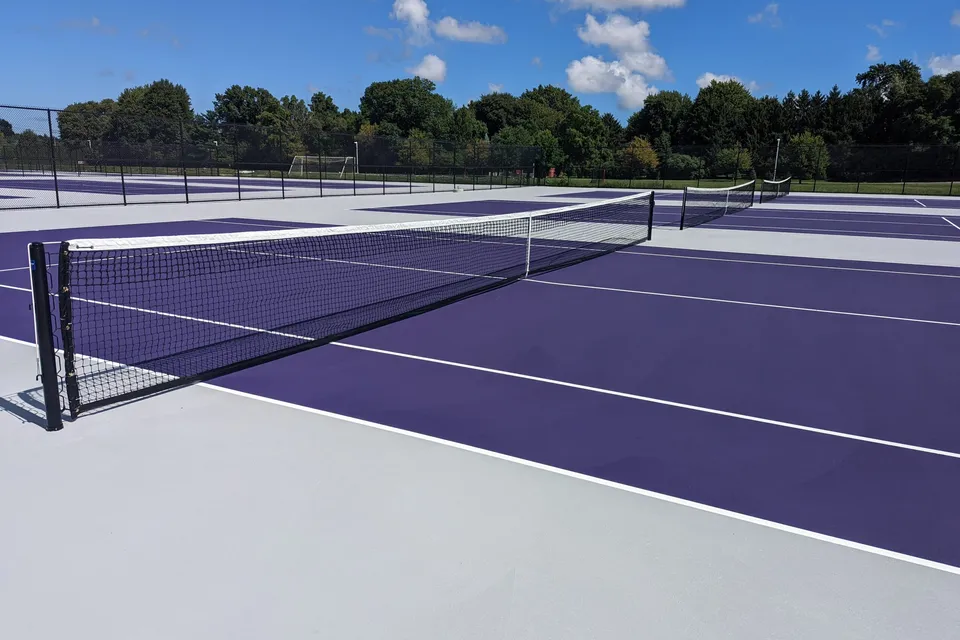
Purple, maroon or red where the game is, Dove Gray or Gray outside, so the dark color is confined to the playing area and the surround stays cool. Avon.
Two blues
Blue inside, Light Blue or Ice Blue outside. Clean, modern, and Ice Blue is the coolest color on the chip.
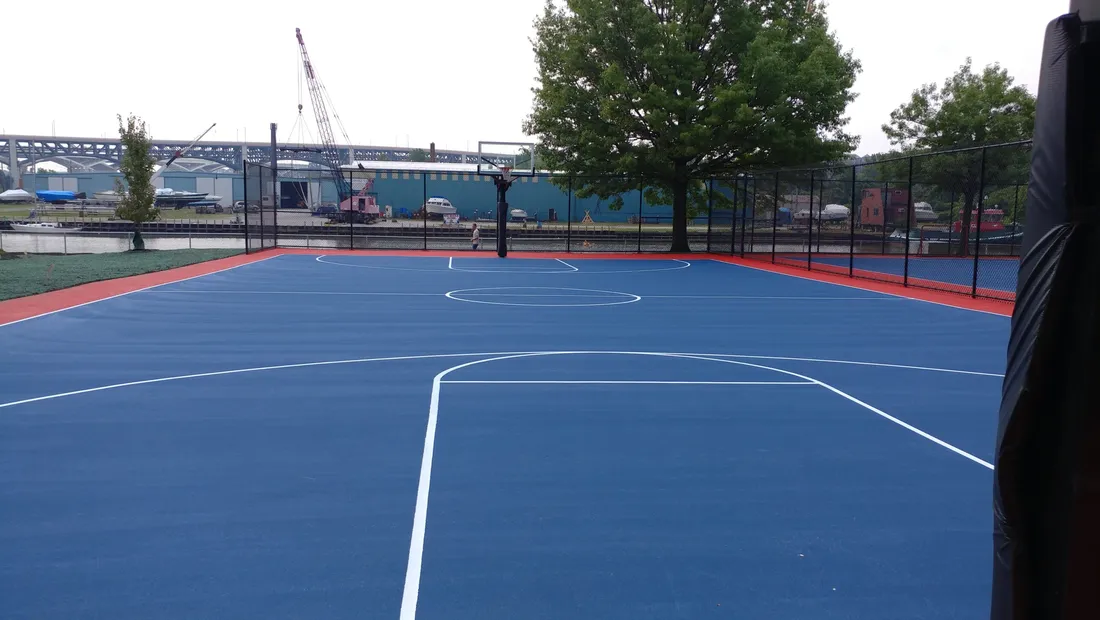
Blue court, red apron
For basketball: a blue court with a Brite Red or Red surround reads from across a park and the red stays cooler than it looks. The riverfront court.
Pickleball on tennis
Tennis lines in white, pickleball in a color two shades from the court: Light Blue on green, Yellow or Dove Gray on blue. Never a second white.
Questions
About color.
Do dark colors really get hotter?
Yes, and by a lot. The chip prints a solar reflectance index for its lighter colors (Ice Blue 62, Sandstone 46, Red 36, Dove Gray 33, Light Green 31); the dark greens, blues, purple and black reflect far less and can run 30 °F or more above a light color on a July afternoon. That is why we put the dark color inside the lines and the lighter one on the surround, where the players stand between points.
Which color shows the ball best?
For a yellow tennis ball, blue and the darker greens; for a pickleball, blue or green against a contrasting surround; for basketball, anything but orange. Light colors make the ball harder to see and show dirt; very dark ones make the lines harder to see at dusk.
Can we match an existing court?
Within a shade. Acrylic color fades with sun over years, so a new court beside an old one will look brighter for a season. On a multi-court facility we phase the work and batch the color so that courts done in the same year match exactly; see phasing a facility.
Can we have a custom color?
SportMaster's ColorPlus Fusion range blends the standard pigments into more than a hundred additional colors, so a school color can usually be matched closely. Custom colors cost more and may need extra coats; we quote them on request.
Free estimates
Pick two, and we will show you.
Tell us the colors you are thinking about and we will bring the chip and a sample board to the site walk.
The yard
4000 East 86th Street, Cleveland, OH 44105
Off Broadway Avenue, south of downtown, ten minutes from I-77 and I-490.
Serving Cuyahoga, Summit, Lake, Lorain, Medina, Geauga, Portage, Stark and Ashtabula counties. Municipal, school, club, HOA and commercial work; residential courts by the job.