

Tennis courts · construction, resurfacing, repair, lines
Tennis courts built, resurfaced and repaired.
New courts on asphalt or post-tensioned concrete, resurfacing with SportMaster acrylic systems, crack repair that does not print through, and lines laid out by hand to the USTA diagram. For parks, schools, colleges, clubs and homes across Northeast Ohio.
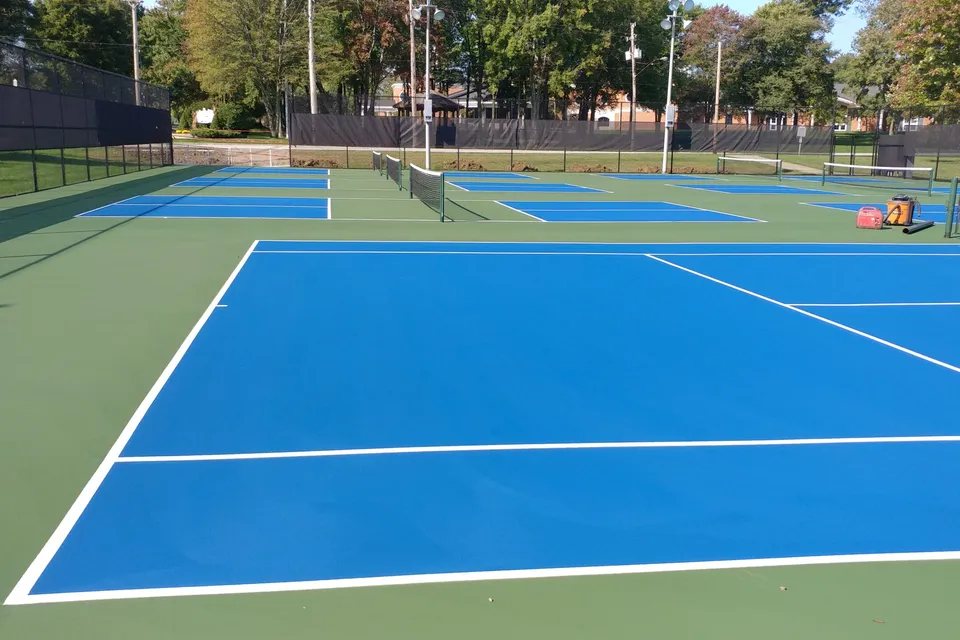
A tennis court is a slab with a coating on it, and both halves have to be right. The slab, asphalt or concrete, has to be flat to a single plane with a 1 percent fall so water leaves and the ball bounces true; the coating has to be applied in the right weather in the right order so it bonds, textures evenly and lasts. We have been doing both in Northeast Ohio since 1957, which means we have seen what every shortcut looks like eight winters later.
Most of our tennis work is resurfacing: bringing a worn court back with crack repair, an acrylic resurfacer and two color coats, which takes about a week and should last four to eight years. We build new courts where there is the room and the budget, repair and level courts that are not ready for a full surface, and line courts for tennis alone or for tennis with pickleball or basketball blended in.
We are members of the American Sports Builders Association and we build to its guidelines and the USTA's. The surfaces are SportMaster acrylic systems, made in Ohio; the crack repair is a fabric-membrane system; the lines are still hand taped and hand painted. The crew that pours the base is the crew that comes back to coat it.
The work
Tennis courts: four jobs, one crew.
Each has its own page with what is included, when you need it, what goes on and what it costs.
Construction
From the soil test to the first serve: a court built on a base that will still be flat in thirty years.
The detailsResurfacing
A worn court brought back in about a week: cleaned, cracks repaired, leveled, resurfaced, colored and lined.
The detailsRepair & leveling
The repairs between surfaces: cracks bridged, birdbaths leveled, heaves cut out, so the court plays safely and the next resurfacing holds.
The detailsLine striping
Lines laid out by hand to the USTA court, taped and painted in textured acrylic, with blended lines for a second sport where a court has to do two jobs.
The detailsProjects
Tennis work you can go and see.
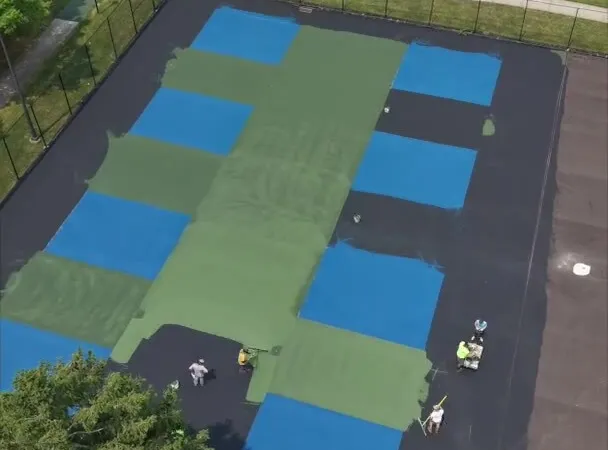
Parma Heights: three tennis and seven pickleball courts at Greenbrier Commons
A city's whole court complex rebuilt in one season, bought through the SportMaster cooperative contract without a separate bid. The biggest job on the public record.
The project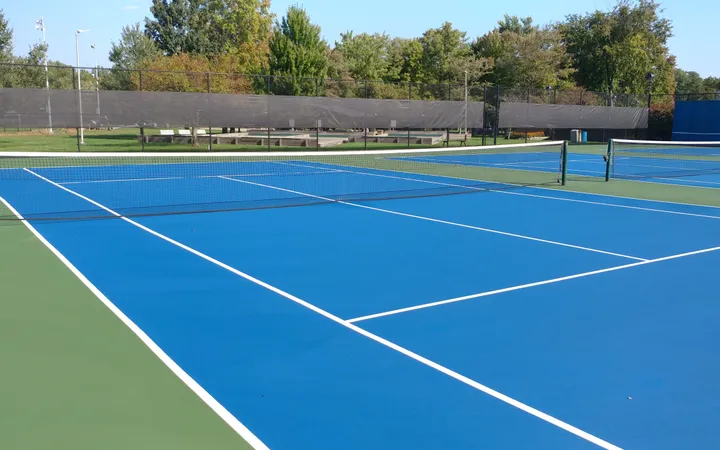
Bay Village: Cahoon Park tennis courts, repaired and resealed
Courts we had resurfaced before, back on our schedule. Repeat customers are the whole business.
The project Bay Village: Bradley Park repairs, and the Reese Park courts as subcontractor
Two parks, two ways of working: direct for the repairs, under a paving prime for the rebuild.
The projectQuestions
About tennis courts.
More on the questions page; the long answers are in the articles below.
Asphalt or concrete for a new court?
Asphalt is the Northeast Ohio standard: two lifts over a compacted stone base, cured for a month, then coated. It costs less and it is what most of the courts around here are. Post-tensioned concrete costs more and does not crack the way asphalt does in our freeze-thaw cycles; for a club or a school planning on forty years it can be the better number. We price both when the site allows it; the article on post-tensioned courts has the arithmetic.
How long does a resurfaced court last?
Four to eight years to the next resurfacing, with the cracks filled every autumn. A sunny, well-drained court that is swept and washed sits at the long end; a shaded court with a low spot sits at the short end. The base underneath, if it was built properly, lasts decades.
Can you add pickleball lines to our tennis court?
Yes. Two or four pickleball courts in a second color, two shades away from the tennis lines so neither game is confused, and portable or permanent nets. It is done as part of a resurfacing or on its own if the surface is sound. See multi-sport courts.
What colors are available?
The full SportMaster ColorPlus range: greens, blues, the US Open pairing of blue inside and green outside, school colors, grays, reds. The color guide shows the combinations and explains heat, glare and visibility.
Reading
From the articles.
Resurface or repaint? How to read a court that is asking for help
Color worn to black in the baseline zones, slick texture, birdbaths after rain: the signs, and what each one means.
Read onWhy court cracks come back, and what actually stops them
A filled crack is a sealed crack, not a fixed one. Freeze-thaw, base movement, and the repairs that hold.
Read onHow often a court needs resurfacing here (and why "every five years" is a guess)
Four years on a shaded, puddled court; eight on a sunny, drained, swept one. What decides it.
Read onFree estimates
Get a number you can plan around.
Send the address and what you have in mind. We walk the site, measure it, and send a written proposal with the scope spelled out: what gets done, what it costs, and when it fits the season.
The yard
4000 East 86th Street, Cleveland, OH 44105
Off Broadway Avenue, south of downtown, ten minutes from I-77 and I-490.
Serving Cuyahoga, Summit, Lake, Lorain, Medina, Geauga, Portage, Stark and Ashtabula counties. Municipal, school, club, HOA and commercial work; residential courts by the job.