


Pickleball courts · Construction & conversion
New pickleball courts, and tennis courts converted to pickleball.
Dedicated courts on a new pad, or two to four courts made from a tennis court: the layout, the base, the surface, the nets and the fence.
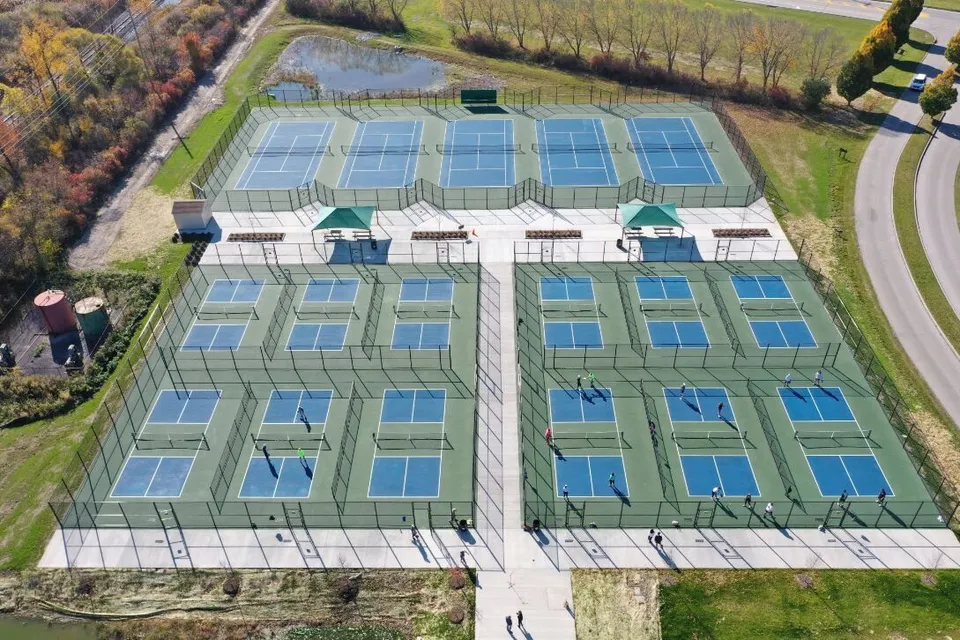
What is included
The job, in order.
-
01
Count and layout
How many courts the site takes, which way they face, where the gates and the waiting benches go. For a conversion: two courts or four, and whether the tennis lines stay.
-
02
Siting for sound
Distance to the nearest homes, what is between, and whether acoustic fence panels are worth it. Decided before anything is built, because it cannot be fixed cheaply after.
-
03
Base
New courts: stone base and two lifts of asphalt or a post-tensioned slab, to a 1 percent plane, cured before coating. Conversions: the tennis base inspected, cracks repaired, low spots leveled.
-
04
Net posts and footings
Permanent posts set in concrete at 22 feet, with the net at 36 inches at the sides and 34 at the center. Portable nets only where a conversion keeps the tennis net.
-
05
Surface
SportMaster acrylic resurfacer and two color coats, with the sand load set for the game. Two colors: one inside the lines, one outside, so the kitchen reads from the baseline.
-
06
Lines
Laid out by tape and square to the USA Pickleball diagram: 20 by 44, kitchen at 7 feet, service courts, 2-inch lines hand taped and hand painted in a contrasting color.
-
07
Fence and rails
Fence per court or per bank, with 4-foot rails between pairs so balls stay on the court they came from. Gates where players actually walk.
-
08
Extras
Benches, shade, ball holders on the fence, a court-number sign on each gate, lighting on timers.
What goes on
Materials, and why.
- Acrylic surface, pickleball texture
- The same SportMaster system as tennis, with a finer sand load for the lighter ball.
- Permanent net systems
- Steel posts in concrete footings with a center strap; the net is the most-used thing on the court.
- Acoustic fence panels
- Sound-absorbing panels hung on the fence facing the neighbors; they take several decibels off the paddle pop.
- Black vinyl-coated chain link
- Disappears visually, lasts, and holds the panels and windscreens.
What it costs
A conversion of one tennis court into pickleball courts costs a fraction of new construction because the base, fence and drainage exist; the net footings and the second color are the main additions. New dedicated courts are priced per court and fall as the count rises. A site walk turns that into a number.
Questions
About construction & conversion.
Also under pickleball courts:
- Resurfacing · Courts that have had three or four hard seasons brought back: cleaned, repaired, resurfaced in two colors, relined.
- Repair & leveling · Cracks bridged and low spots leveled between surfaces, including the old tennis seams that come through on converted courts.
- Line striping · Lines to the USA Pickleball diagram, laid out by hand, and blended-line layouts that put pickleball on a tennis or basketball court without confusing either game.
How long does a conversion take?
About two weeks for a tennis court becoming four pickleball courts: repairs and leveling, new net footings (which have to cure), the surface, the lines and the fence work. A simple blended-line job is a week.
Can we keep the tennis net?
For a two-court conversion, yes: the two pickleball courts sit either side of the tennis net line with their own portable or permanent nets, and the tennis net stays for tennis. For four courts the tennis net comes out.
Do dedicated courts need their own fence?
They need something between pairs, or every point ends with someone walking onto the next court. Rails between pairs and a perimeter fence is the usual answer; full fencing per court is quieter and costs more.
Reading
From the articles.
Turning a tennis court into pickleball courts, properly
Two courts or four, blended lines or dedicated, and why the surface has to be right before any color goes on.
Read onAcrylic or modular tiles for an outdoor pickleball court
Tiles go down fast and come up fast. Acrylic plays truer and lasts. The honest comparison for Ohio weather.
Read onPickleball noise: where to put the courts and what to build around them
The pop of a paddle carries. Setbacks, acoustic fence, paddles and hours: what works before the neighbors organize.
Read onFree estimates
Get a number you can plan around.
Send the address and what you have in mind. We walk the site, measure it, and send a written proposal with the scope spelled out: what gets done, what it costs, and when it fits the season.
The yard
4000 East 86th Street, Cleveland, OH 44105
Off Broadway Avenue, south of downtown, ten minutes from I-77 and I-490.
Serving Cuyahoga, Summit, Lake, Lorain, Medina, Geauga, Portage, Stark and Ashtabula counties. Municipal, school, club, HOA and commercial work; residential courts by the job.