


Pickleball courts · Resurfacing
Pickleball court resurfacing.
Courts that have had three or four hard seasons brought back: cleaned, repaired, resurfaced in two colors, relined.
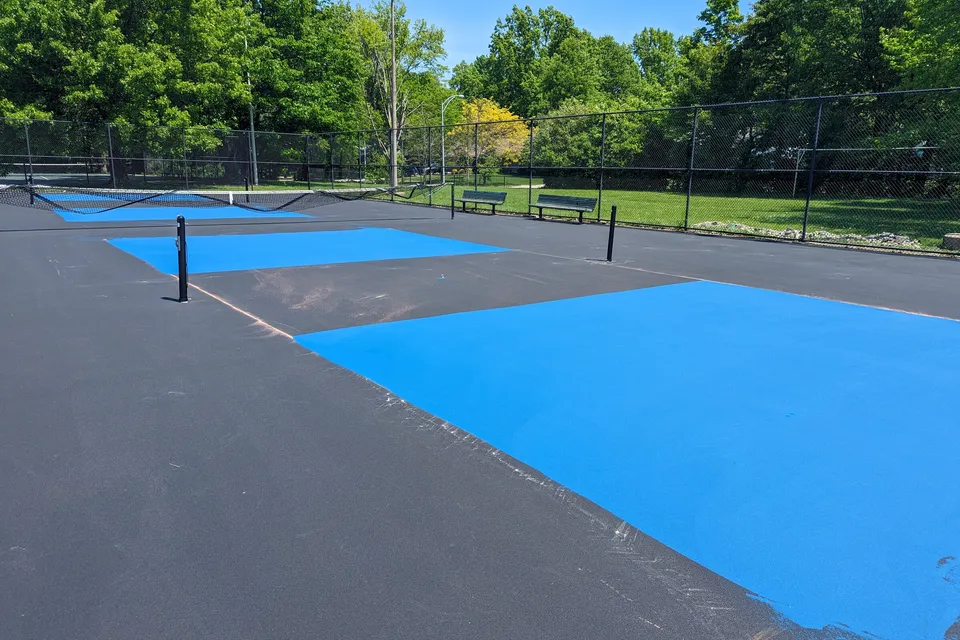
What is included
The job, in order.
-
01
Inspection and map
Cracks, low spots, worn zones (the kitchen line and the baselines wear first on a pickleball court), net posts and fence.
-
02
Pressure washing
To bare sound surface, with algae treated where the courts sit in shade.
-
03
Repairs
Cracks bridged with a fabric-membrane system, hairlines filled, birdbaths leveled with patch binder.
-
04
Resurfacer and color
Acrylic resurfacer, then two coats of ColorPlus in two colors, the sand load set for pickleball.
-
05
Lines
Relaid by hand from the net line, because the old lines are not always where they should have been, and painted in two coats of textured line paint.
-
06
Nets and hand over
Nets set to 34 inches at the center, posts checked, play after a day or two.
When you need it
The signs.
- Kitchen lines and baselines worn through to the black
- A surface that has gone slick and fast
- Puddles in the kitchen after rain
- Cracks reopening along the old tennis seams on a converted court
- Color coming off on paddles and balls
What it costs
Pickleball courts are small, so resurfacing is priced per bank rather than per court; four courts on one tennis pad cost about what one tennis court does, plus the second color and the extra lines.
Questions
About resurfacing.
Also under pickleball courts:
- Construction & conversion · Dedicated courts on a new pad, or two to four courts made from a tennis court: the layout, the base, the surface, the nets and the fence.
- Repair & leveling · Cracks bridged and low spots leveled between surfaces, including the old tennis seams that come through on converted courts.
- Line striping · Lines to the USA Pickleball diagram, laid out by hand, and blended-line layouts that put pickleball on a tennis or basketball court without confusing either game.
How often does a pickleball court need resurfacing?
Pickleball courts see more hours of play per square foot than tennis courts, and the wear concentrates at the kitchen line. Four to six years is typical in Northeast Ohio for a busy public bank; a lightly used club court goes longer. The cracks still want filling every autumn.
Can the colors be changed?
Yes; resurfacing is the time. Many owners move from a single color to two, with a darker court and a lighter surround, which makes the kitchen easier to see and the court cooler.
Reading
From the articles.
Resurface or repaint? How to read a court that is asking for help
Color worn to black in the baseline zones, slick texture, birdbaths after rain: the signs, and what each one means.
Read onHow often a court needs resurfacing here (and why "every five years" is a guess)
Four years on a shaded, puddled court; eight on a sunny, drained, swept one. What decides it.
Read onCourt colors, heat and glare: what the color chip does not tell you
Dark blue inside, green outside, for a reason. Temperature, glare and visibility, by color.
Read onFree estimates
Get a number you can plan around.
Send the address and what you have in mind. We walk the site, measure it, and send a written proposal with the scope spelled out: what gets done, what it costs, and when it fits the season.
The yard
4000 East 86th Street, Cleveland, OH 44105
Off Broadway Avenue, south of downtown, ten minutes from I-77 and I-490.
Serving Cuyahoga, Summit, Lake, Lorain, Medina, Geauga, Portage, Stark and Ashtabula counties. Municipal, school, club, HOA and commercial work; residential courts by the job.