


Pickleball courts · Repair & leveling
Pickleball court crack repair and leveling.
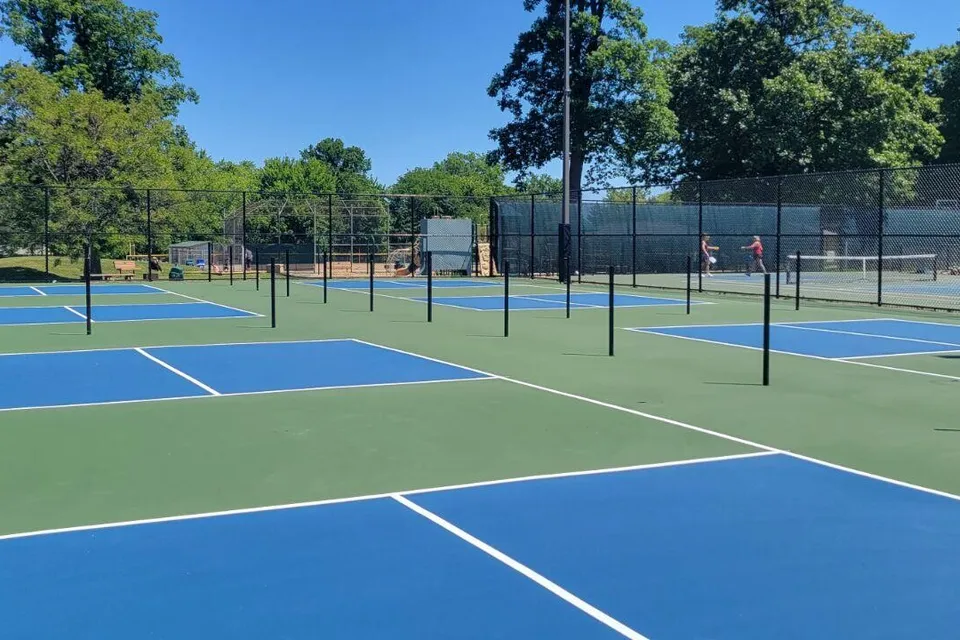
Cracks bridged and low spots leveled between surfaces, including the old tennis seams that come through on converted courts.
What is included
The job, in order.
-
01
Map
Cracks chalked, low spots flooded and marked, net post footings checked for heave.
-
02
Crack repair
Hairlines filled with acrylic filler; working cracks and old seams bridged with a fabric-membrane system.
-
03
Leveling
Birdbaths, especially in the kitchen where they matter most, filled with acrylic patch binder and feathered out.
-
04
Footings
Heaved or loose net post footings reset; a net that leans is a court nobody books.
-
05
Touch-up
Repairs coated to match when the court is not due for a full surface.
When you need it
The signs.
- A crack across a kitchen line
- The old tennis court's seams showing through a conversion
- Puddles in the kitchen or at the baseline
- A net post that moves in its sleeve, or leans after a winter
What it costs
Priced by the linear foot of crack and the square foot of leveling from the map made on the site walk.
Questions
About repair & leveling.
Also under pickleball courts:
- Construction & conversion · Dedicated courts on a new pad, or two to four courts made from a tennis court: the layout, the base, the surface, the nets and the fence.
- Resurfacing · Courts that have had three or four hard seasons brought back: cleaned, repaired, resurfaced in two colors, relined.
- Line striping · Lines to the USA Pickleball diagram, laid out by hand, and blended-line layouts that put pickleball on a tennis or basketball court without confusing either game.
Why do converted courts crack along the old lines?
They do not, exactly: they crack where the tennis slab had its seams and working cracks, which were filled rather than bridged before the conversion. A filled crack reflects through color within a winter or two. Bridging with a membrane is the fix, and the reason we do it the first time.
When should this be done?
Autumn, before the freeze, so water stays out of the cracks all winter; or in spring as the first step of a resurfacing.
Reading
From the articles.
Why court cracks come back, and what actually stops them
A filled crack is a sealed crack, not a fixed one. Freeze-thaw, base movement, and the repairs that hold.
Read onFill the cracks before the first freeze
The cheapest hour of maintenance all year is the one spent filling cracks in October.
Read onPuddles on a court: what the birdbath test tells you
A nickel under the water is fine; a quarter is not. Finding and fixing low spots before they become bare spots.
Read onFree estimates
Get a number you can plan around.
Send the address and what you have in mind. We walk the site, measure it, and send a written proposal with the scope spelled out: what gets done, what it costs, and when it fits the season.
The yard
4000 East 86th Street, Cleveland, OH 44105
Off Broadway Avenue, south of downtown, ten minutes from I-77 and I-490.
Serving Cuyahoga, Summit, Lake, Lorain, Medina, Geauga, Portage, Stark and Ashtabula counties. Municipal, school, club, HOA and commercial work; residential courts by the job.