


SportMaster authorized installer · Northeast Ohio
Crack fillers and patch binder: SportMaster's repair products, and where each one fits.
The fillers, sealants and patching mix SportMaster makes for tennis, pickleball and basketball courts, read from SportMaster's own sheets: how wide a crack each one takes, how deep a low spot, how long it wants before the coating goes on. Then where each one fits in a repair here, and where a crack that keeps moving gets a membrane instead.
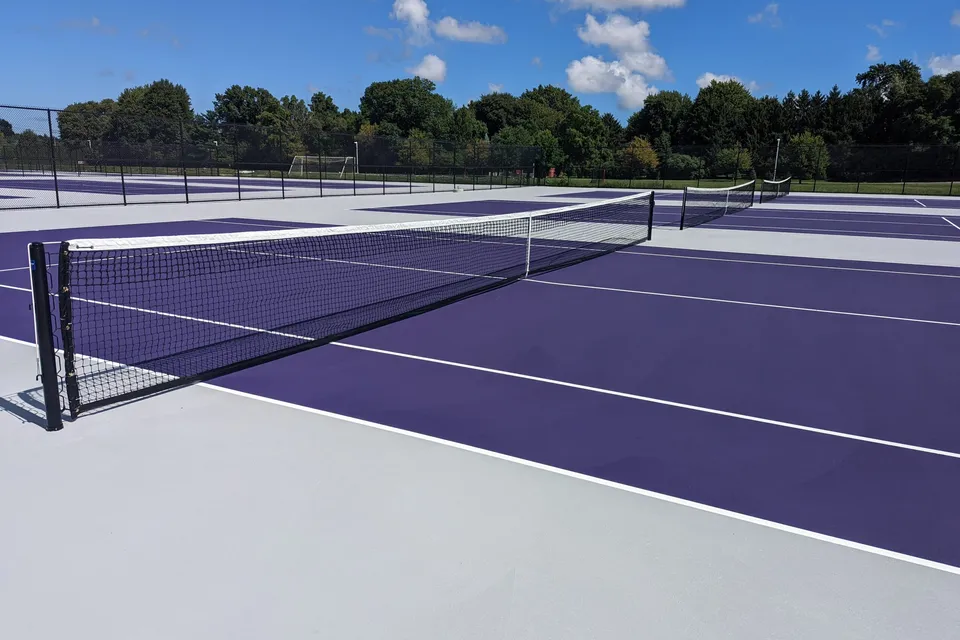
Every court repair ahead of a color coating comes down to three kinds of damage: cracks, low spots that hold water, and cracks that will not stay closed. SportMaster makes water-based acrylic products for the cracks and the low spots. Acrylic Crack Patch is a trowel-grade, sand-filled filler that sets up hard. Crack Magic and CourtFlex are elastomeric sealants that stay flexible; Crack Magic goes on with a putty knife or trowel, CourtFlex pours from the jug. Clear Crack Sealant goes on white and dries clear, so the repair shows less. Acrylic Patch Binder is a liquid mixed on site with sand and cement into a patching mix that levels low spots and fills cracks. They are acrylics, like the resurfacer and color coats that go over them, and SportMaster's best practices say an asphalt-based crack filler, hot or cold, never goes on a court.
A filled crack is maintenance, not a cure, and SportMaster says so in its own words. Its answer sheet on how long acrylic crack filler lasts explains that most court cracks are structural, running through the pavement into the base, with two slabs moving against each other every day, so a filled crack may open again within days, weeks, months or years. That is our position too. Where a crack is a working crack on a court we are coating, we bridge it with a fabric-membrane system, which is not a SportMaster product; how it works and when it is the answer is on our crack repair page.
This page is the product view: each SportMaster repair product, what its sheet says it is for, and where it fits. For the repair as a service, the five options from an afternoon's filling to a rebuild, and how we decide which crack gets which, read court crack repair. For what goes over the repairs, read the ColorPlus color coating system.
The products
Five SportMaster repair products, by the sheet.
Each has a data sheet of its own, and the name opens it. The middle column is the size of repair the sheet gives.
| Product | For | What it is |
|---|---|---|
| Acrylic Crack Patch | Cracks up to 1 inch wide | A trowel-grade, sand-filled acrylic filler for cracks and damaged areas in asphalt or concrete courts, used straight from the pail, never diluted, and worked into the crack with a trowel or putty knife, the excess wiped off with a damp cloth before it dries. It sets up hard and textured like the court surface. Green, red, blue or neutral. |
| Crack Magic | Cracks up to 1/2 inch wide | An elastomeric acrylic crack sealant fortified with fibers, applied with a putty knife or trowel, filled completely, smoothed flush and feathered at the edges. SportMaster's sheet names it for concrete expansion joints and its guide calls it especially good on cracks that move. Green, red or neutral; the neutral can be tinted with ColorPlus pigment dispersion. |
| CourtFlex | Cracks up to 1/2 inch wide | An elastomeric cold-pour crack sealant, poured from the jug until the crack is full, then scraped and squeegeed so it finishes at or below the surface. Its sheet says it keeps its flexibility and adhesion down to -15 °F; its guide says more than one pour may be needed as it settles into the crack. Green, red or neutral. |
| Clear Crack Sealant | Recommended for smaller cracks | An elastomeric acrylic sealant that goes on white and dries clear, made for asphalt, concrete and existing acrylic sport surfaces; it dries clear to make the repair less noticeable. Its sheet recommends it for smaller cracks and says that in a crack wider than a quarter inch it may dry with a haze. |
| Acrylic Patch Binder | Low spots up to 3/4 inch deep; cracks up to 1 inch wide | A milky-white liquid acrylic binder mixed on site with sand and cement into a patching mix, for leveling low spots and birdbaths and for filling cracks. Laid with a smooth screed or trowel, feathered at the edges, in more than one lift on a deeper patch. It is what we level birdbaths with. |
Which repair
The damage decides the product.
Hairlines and narrow cracks that are not moving
Acrylic crack filler, worked in flush. SportMaster's trowel-grade filler is Acrylic Crack Patch; its sheet takes it up to cracks 1 inch wide, but SportMaster's own guide to filling cracks says that because it is sand-filled it will likely re-crack under freeze-thaw where the base moves. So on our courts filler is for hairlines and narrow cracks that are not moving, and the crack's behavior, not only its width, decides.
A crack that keeps moving
This is the crack that comes back through the color every spring. On a court we repair it gets the fabric-membrane system: the crack filled flush, a flexible fabric bonded over it in acrylic, the edges feathered out with patch binder, then the resurfacer and color with the rest of the court. That system is ours to explain, not SportMaster's; it is on our crack repair page, with the honest version of how long it lasts.
Low spots and birdbaths
Acrylic Patch Binder, mixed on site with sand and cement and laid with a screed or trowel, feathered at the edges. SportMaster's specification asks for depressions of 1/8 inch or deeper to be leveled before the resurfacer, and the binder's sheet rates the mix for low spots up to 3/4 inch deep. We find them by flooding the court and chalking the water line, as on the puddles article; a deep spot, or a court out of plane, is a cut-out or an overlay, and the article says where we draw that line.
Concrete joints and flexible sealing
Crack Magic is SportMaster's fiber-filled elastomeric sealant, and its sheet names it for concrete expansion joints; CourtFlex is the pourable one. SportMaster's guide warns that a coating painted over a flexible sealant may flake off as the crack moves, like painting a balloon, and suggests tinting the neutral sealant to the court color instead. On a concrete court, cracks are cleaned, filled with a flexible sealant and bridged before coating, as our crack repair page says.
Wide cracks, spalls and heaves
Past what a filler or a membrane can handle, the failed section is cut out, the base compacted and new asphalt placed, then sealed and coated; a base that has failed across the court is an overlay or a rebuild. Those are on our crack repair page and in why cracks come back.
How a repair runs
From the map to the color.
-
01
Map the court
We walk the court, chalk every crack, flood it to find the low spots and decide which crack gets which repair. The map we make on the walk is the quote, and it is the maintenance record afterward (how we work).
-
02
Clean and dry the cracks
SportMaster's sheets ask for every crack to be cleaned of dust, dirt, debris and vegetation, blown out with an air compressor or a high-pressure washer. Its answer sheet on crack filler that will not dry adds two or three days of dry weather after pressure washing before any sealant goes in, and no crack filling just before or after heavy rain, because water rising from under the court keeps the filler wet. We take the cracks back to sound edges, with the algae and the old filler out.
-
03
Bottom-fill the deep ones
SportMaster does not want a deep crack filled to the top with sealant. Its CourtFlex sheet asks for sand or backer rod to within 3/4 inch of the surface, and its guide to filling cracks adds cement as a third choice, so the water-based filler has a shallow channel to set up in and enough sides to bond to.
-
04
Fill the hairlines, bridge the working cracks
Hairlines take acrylic crack filler, worked down into the crack with a trowel or putty knife and the excess wiped off with a damp cloth before it dries, as the Acrylic Crack Patch sheet describes, so nothing stands proud under the color. Working cracks are filled flush and bridged with the fabric membrane, described step by step on our crack repair page.
-
05
Level the low spots
Acrylic Patch Binder is mixed by SportMaster's mixing procedure: the sand and cement blended dry first, the binder poured in while stirring, added water avoided, and only as much mixed as can be laid in 30 to 60 minutes. The data sheet asks for 2 to 4 minutes of mixing and no more, because overmixing traps air and weakens the patch. The mix is screeded or troweled, the edges feathered, and a patch deeper than 1/2 inch goes down in lifts. We flood the court again after each lift, as the puddles article describes.
-
06
Let it dry
Every one of these sheets asks for surface and air above 50 °F during application and for 24 hours after, with no rain coming. Acrylic Crack Patch takes from 1 hour to a full day by its sheet, depending on the size of the repair and the weather; the patch binder mix must harden completely, and Crack Magic must dry, before any coating goes over them.
-
07
Resurfacer and color
The repairs take the Acrylic Resurfacer and color coats with the rest of the court and disappear under them. SportMaster's guide specification asks for every repair to be flush and smooth with the surface around it, and for 2 coats of resurfacer where the cracks and low-spot repairs are extensive. The coating itself is on the color coating system page. If the court is not due for resurfacing, the repairs are coated to match.
The numbers
What SportMaster's sheets say.
Taken from the maker's own documents and checked against them each time this site is built. The sheet named beside each figure is the authority; open it before you write a specification.
| What | The sheet says | Which sheet |
|---|---|---|
| Acrylic Crack Patch, crack width (SportMaster's guide) | 1/8 inch up to 1 inch | How to fill cracks on a tennis court: which products to use |
| Crack Magic, crack width | Up to 1/2 inch | Crack Magic technical data sheet |
| Deep cracks, bottom-filled | Sand or backer rod to within 3/4 inch of the surface | CourtFlex technical data sheet |
| Which cracks get filled | Over 1/8 inch wide, with an acrylic sealant; never an asphalt-based filler | 10 best practices of repairing and resurfacing tennis and basketball courts |
| Low spots that get leveled | 1/8 inch or deeper | Color coating systems over asphalt engineering specification |
| Acrylic Patch Binder, depth | Low spots up to 3/4 inch deep | Acrylic Patch Binder technical data sheet |
| Patches deeper than 1/2 inch | Laid in more than one lift | Acrylic Patch Binder technical data sheet |
| Patch mix, one batch (mixing procedure) | 1 gallon binder, 30 lbs silica sand (50 to 60 mesh), 6 lbs cement | Acrylic Patch Binder, 1-gallon batch mixing procedure |
| Patch mix, mixing time | 2 to 4 minutes, no more | Acrylic Patch Binder technical data sheet |
| Air and surface temperature | Above 50 °F (10 °C), during and for 24 hours after | Acrylic Crack Patch technical data sheet |
| Acrylic Crack Patch, drying | 1 hour up to a full day | Acrylic Crack Patch technical data sheet |
| After pressure washing | Two or three dry days before crack sealant | Why is the crack filler not drying on my tennis court? |
| How long a filled crack stays closed | It may open within days, weeks, months or years | How long should acrylic crack filler last on a tennis or sport court? |
| Resurfacer over heavy repair | 2 coats | Tennis: color coating system, over asphalt guide specification |
Local work
Repair work you can go and see.
Court repair jobs; each project page says what was done.
-
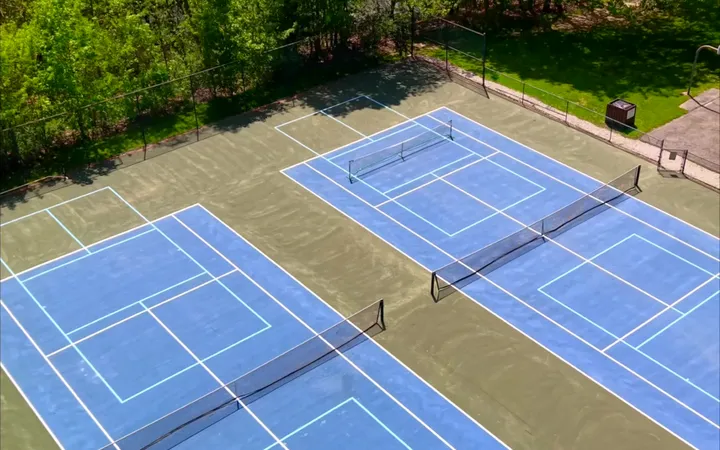
Pickleball · Court surfacing
Tanglewood: pickleball courts by the lake in Bainbridge Township
Courts in a clearing by the lake in Geauga County's snow belt, back to true after a winter that had not been kind to them.
-
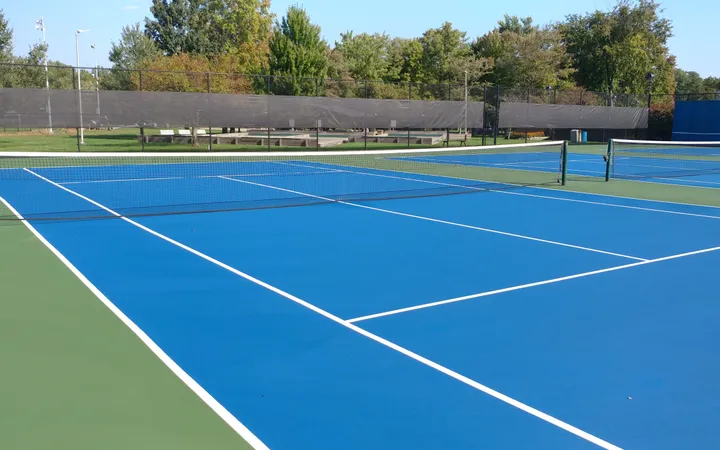
Tennis · Repair and resurfacing
Bay Village: Cahoon Park tennis courts, repaired and resealed
Courts we had resurfaced before, back on our schedule. Repeat customers are the whole business.
-
Tennis · Repair; court surfacing as subcontractor
Bay Village: Bradley Park repairs, and the Reese Park courts as subcontractor
Two parks, two ways of working: direct for the repairs, under a paving prime for the rebuild.
The sheets
SportMaster's documents for these products.
The maker's own data sheets, safety data sheets, specifications and procedures, kept in our documents library so they are at hand for an owner, an architect or a crew. Each opens on a page that shows the document and offers the file.
Data sheets
The five repair products.
Fichas técnicas (Spanish)
Mixing procedure
Acrylic Patch Binder, one-gallon batch.
Safety data sheets
Every color: Acrylic Crack Patch green, red, blue and neutral; CourtFlex green, red and neutral; Crack Magic green, red and neutral; Clear Crack Sealant; Acrylic Patch Binder.
- Acrylic Crack Patch, Green · safety data sheet
- Acrylic Crack Patch, Red · safety data sheet
- Acrylic Crack Patch, Blue · safety data sheet
- Acrylic Crack Patch, Neutral · safety data sheet
- CourtFlex, Green · safety data sheet
- CourtFlex, Red · safety data sheet
- CourtFlex, Neutral · safety data sheet
- Crack Magic, Green · safety data sheet
- Crack Magic, Red · safety data sheet
- Crack Magic, Neutral · safety data sheet
- Clear Crack Sealant · safety data sheet
- Acrylic Patch Binder · safety data sheet
Guides and answer sheets
Which filler for which crack, how long filler lasts, why filler will not dry, and SportMaster's best practices for repairing and resurfacing.
Specifications
Surface preparation and repair ahead of the color coating, over asphalt and over concrete.
Maintenance
Questions
Asked on the site walk.
Pages that go with this one:
- Court crack repair · The service: the fabric-membrane repair and the five options, from filling to a rebuild.
- ColorPlus color coating system · The resurfacer and color coats that go over the repairs.
- Tennis court repair and leveling · Cracks bridged, birdbaths leveled, heaves cut out, between surfaces.
- Pickleball court repair and leveling · The same work on pickleball courts, including old tennis seams.
- Why cracks come back · Filling a crack against repairing one, and what a membrane does.
- Puddles on a court · The birdbath test and how a low spot is leveled.
- Court maintenance · Keeping any acrylic court clean, drained and crack free.
The other SportMaster pages:
Will the cracks come back after they are filled?
Often, yes, and SportMaster says so itself: its answer sheet on crack filler says most court cracks are structural and that a filled crack may open within days, weeks, months or years, depending on how much the slab moves and how hard the winter is. It calls crack filling a maintenance job. That is why a working crack on a court we coat gets a fabric membrane over it rather than filler alone, as our crack repair page explains; nothing is permanent, but in our experience the surface above it stays whole for years.
Which filler goes in which crack?
By SportMaster's sheets, Acrylic Crack Patch is the trowel-grade filler for cracks from 1/8 inch up to 1 inch, Crack Magic and CourtFlex are the flexible sealants for cracks up to 1/2 inch, and Acrylic Patch Binder mix fills cracks up to 1 inch and levels low spots. On our courts the hairlines get acrylic filler and the cracks that move get the membrane, because SportMaster's own guide says the sand-filled filler will likely re-crack where the base moves. SportMaster's best practices rule out an asphalt-based filler, hot or cold, on a court; hot-pour rubber is the material for parking lots, which are not color-coated.
Can a birdbath be leveled without resurfacing the court?
Yes. The low spot is filled with Acrylic Patch Binder mix, feathered out past the water line, and then given a color coat to match, as the puddles article describes. SportMaster's sheet rates the mix for low spots up to 3/4 inch deep, in more than one lift past 1/2 inch; a deep spot, or a court that has settled out of plane, needs a cut-out or an overlay instead, and the article says where we draw that line.
How soon can the repairs be coated?
When they are dry through, which the sheets tie to the weather rather than the clock. Acrylic Crack Patch takes from 1 hour to a full day by its sheet, the patch binder mix must harden completely, and all of them want surface and air above 50 °F for 24 hours after they go in. Water under the court slows everything, which is why SportMaster's answer sheet on crack filler that will not dry asks for dry days after a pressure washing, and no filling just before or after heavy rain.
When is the best time to repair the cracks?
Our advice is autumn, before the first freeze, so water cannot get into the cracks and work on them all winter; the October article explains why. SportMaster's answer sheet suggests checking a court in spring and early fall while the temperature stays above 50 °F, and its maintenance manual recommends a spring inspection for cracks that have appeared or reopened. When a court is due for resurfacing, the repairs are the first day of that job.
Are pickleball courts repaired the same way?
Yes. SportMaster's sheets list pickleball courts among the uses for Acrylic Crack Patch, CourtFlex and Clear Crack Sealant, and the method is the same: hairlines filled, working cracks bridged, birdbaths leveled with patch binder, then resurfacer and color. On a tennis court converted to pickleball, the old seams are the cracks to watch; see pickleball court repair and leveling.
Free estimates
A SportMaster court, from the installer down the road.
Send the address and what you have in mind. We walk the site, measure it, and send a written proposal that names the system, the coats and the season it fits.
The yard
4000 East 86th Street, Cleveland, OH 44105
Off Broadway Avenue, south of downtown, ten minutes from I-77 and I-490.
Serving Cuyahoga, Summit, Lake, Lorain, Medina, Geauga, Portage, Stark and Ashtabula counties. Municipal, school, club, HOA and commercial work; residential courts by the job.