

SportMaster authorized installer · Northeast Ohio
Cushioned courts: rubber under the color, a sound base under the rubber.
Rubber-filled acrylic coats built up under the color of a tennis, pickleball or basketball court. As an authorized SportMaster installer we install the ProCushion system, in the standard or the premium build, over asphalt or concrete, for courts in Cleveland and Northeast Ohio.
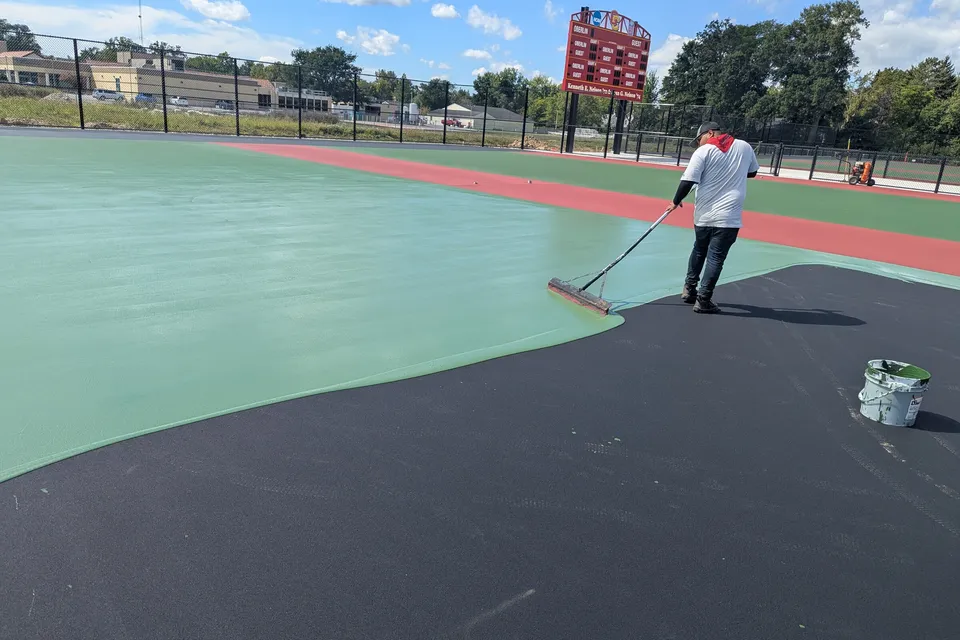
A cushioned court is an acrylic court with rubber built in under the color. Over the asphalt or concrete and the Acrylic Resurfacer go a series of coats of CushionMaster II, an acrylic coating filled with coarse rubber particles that builds the cushion, then coats of CushionMaster I, the same kind of coating with fine rubber particles that smooths the texture. The color coats and the lines go on top.
SportMaster calls the system ProCushion and writes it in two builds. The standard build is 3 coats of CushionMaster II and 2 of CushionMaster I; the premium build puts down 5 coats of CushionMaster II under the same 2 of CushionMaster I. SportMaster's ProCushion maintenance sheet says of its tennis system that the buildup of these coats "provides a softer, cushioned effect to players and minimizes fatigue and shock in the joints and body." Those are the maker's words.
As an authorized SportMaster installer we install ProCushion for tennis, pickleball and basketball courts on asphalt or concrete. It is the same family of acrylic coatings, the same squeegees and the same order of work as the color coating system, with more coats, more drying between them, and less patience for a base that is not right.
What goes down
The system, from the pavement up.
Each layer is a SportMaster product with a data sheet of its own. The name opens it.
| Layer | Coats | What it does |
|---|---|---|
| Acrylic Adhesion Promoter (on concrete) | 1 coat | Primes a new or uncoated concrete slab, after it has been roughened and acid etched, so the coats above it bond. |
| Acrylic Resurfacer | 1 or 2 coats | Sand-filled acrylic that fills the pavement texture and gives the rubber coats an even, smooth base; the specification asks for the second coat on new asphalt and on old courts with extensive crack or low-spot repair. On concrete the engineering specification asks for 1 or more coats. |
| CushionMaster II (coarse rubber) | 3 coats standard, 5 coats premium | The base cushion: acrylic with coarse rubber particles, squeegeed one coat at a time, each dry before the next. This is where the build gets its height. |
| CushionMaster I (fine rubber) | 2 coats, both builds | The finish cushion: the same acrylic with fine rubber particles, which smooths the coarse texture so the color coats go on evenly. |
| Color coats | 2 coats minimum | The playing surface and its color. SportMaster's tennis and basketball guide specifications name Flexible Concentrate, an elastomeric color coat made to stay flexible over the cushion. |
| Stripe Rite primer and line paint | 1 coat of line paint minimum | Lines laid out to the sport's rules and taped; the primer seals the tape edge against bleed-under, then the line paint. Ours are hand taped and hand painted. |
When we recommend it
The court it suits.
Courts where people play for hours
Clubs whose members play every day, school and college courts used by teams for hours at a time, and a family's private court are where we recommend a cushion, as our cushioned courts article sets out. The people who will stand on it are the reason for the job.
A sound base first
A cushion does not fix a failing base. A slab that heaves, holds water or has cracked across needs repair or rebuilding before anything else, and SportMaster's sheets ask for a surface that is smooth and level, with every repair flush, before the first cushion coat. On concrete the specification also asks for a suitable vapor barrier beneath the slab and perimeter drainage so moisture does not collect under it.
When the standard system is the better answer
For an open park bank used by whoever walks in, we usually recommend the plain color coating system and spending the difference on drainage, lights or another court. A cushioned system costs more, and it is the one line on a proposal that can be left off without hurting the court; the base, the crack repair and the color coats cannot.
Standard or premium
Both builds use the same products in the same order. The premium build adds coats of CushionMaster II, and SportMaster's CushionMaster II data sheet says additional coats may be applied for added resiliency. Which build suits a court is a question for the site walk and for the people who will play on it.
How the job runs
The work, in order.
-
01
The site walk
We walk the court, check the plane, map the cracks and look at where the water sits, as on any job (how we work). If the base is not sound we say so, and we price the repair or the rebuild before any cushion.
-
02
Cleaning
The court is pressure washed to a bare, sound surface. SportMaster's guide specification asks for the whole surface to be washed and for dirt, oil, grease, vegetation and loose material to come off before anything goes down.
-
03
Cracks and low spots
Cracks are repaired first: how we do it is on our crack repair page, and the SportMaster fillers and patch binder are on a page of their own. Depressions of 1/8 inch and deeper are leveled with patch binder, as the specification asks, so the cushion goes down on a true plane.
-
04
Concrete preparation
On concrete, SportMaster's ProCushion specification over concrete asks for a slab cured 28 days with moisture curing only, a broom finish or similar roughened texture and never a steel trowel, an acid etch rinsed clean, and Acrylic Adhesion Promoter or a suitable primer on new or uncoated concrete.
-
05
Acrylic Resurfacer
1 or 2 coats of resurfacer fill the texture. Over an old acrylic court, SportMaster's CushionMaster II sheet asks for resurfacer so the rubber granules go down evenly.
-
06
The cushion coats
CushionMaster II goes on with a soft rubber squeegee, one coat at a time, each dry before the next: 3 coats for the standard build, 5 for the premium. Then 2 coats of CushionMaster I. SportMaster's sheets give 3 to 4 hours of drying for CushionMaster II and 30 to 60 minutes for CushionMaster I under optimum drying conditions, which is why a cushioned job takes longer than a standard one.
-
07
Color coats
At least 2 color coats go over the dry cushion, squeegeed the same way as on any SportMaster court.
-
08
Lines
Laid out to the USTA, USA Pickleball or basketball rules, taped, primed with Stripe Rite and painted by hand.
-
09
Weather and cure
Every coat needs surface and air above 50 °F during application and for 24 hours after, and no rain coming, so the job is planned inside our May to mid October season. SportMaster's guide specifications allow play after a minimum of 24 hours. The maintenance sheet says acrylic coatings take 14 days to reach full film cure, and that nothing heavy should go on a cushioned surface at any time, above all before then.
The numbers
What SportMaster's sheets say.
Taken from the maker's own documents and checked against them each time this site is built. The sheet named beside each figure is the authority; open it before you write a specification.
| What | The sheet says | Which sheet |
|---|---|---|
| Standard build | 3 coats CushionMaster II, then 2 coats CushionMaster I | ProCushion System over asphalt engineering specification |
| Premium build | 5 coats CushionMaster II, then 2 coats CushionMaster I | ProCushion System over asphalt engineering specification |
| CushionMaster II | Coarse rubber particles, for cushion build | CushionMaster II technical data sheet |
| CushionMaster I | Fine rubber particles, for smooth texture | CushionMaster I technical data sheet |
| CushionMaster II coverage | 0.15 gallons per square yard per coat | CushionMaster II technical data sheet |
| CushionMaster I coverage | 0.10 to 0.12 gallons per square yard per coat | CushionMaster I technical data sheet |
| CushionMaster II drying | 3 to 4 hours per coat, optimum drying conditions | CushionMaster II technical data sheet |
| CushionMaster I drying | 30 to 60 minutes per coat, optimum drying conditions | CushionMaster I technical data sheet |
| Acrylic Resurfacer drying | 30 to 60 minutes, optimum drying conditions | Acrylic Resurfacer technical data sheet |
| Air and surface temperature | Above 50 °F (10 °C), during and for 24 hours after | CushionMaster II technical data sheet |
| New asphalt cure before coating | 14 to 30 days | ProCushion System over asphalt engineering specification |
| New concrete cure before coating | 28 days | ProCushion System over concrete engineering specification |
| Low spots leveled first | 1/8 inch and deeper | Tennis: cushioned system, standard, over asphalt guide specification |
| Before play (tennis guide specification) | 24 hours minimum | Tennis: cushioned system, standard, over asphalt guide specification |
| Full film cure | 14 days | ProCushion System maintenance |
The sheets
SportMaster's documents for this system.
The maker's own data sheets, safety data sheets, specifications and procedures, kept in our documents library so they are at hand for an owner, an architect or a crew. Each opens on a page that shows the document and offers the file.
Cushion data sheets
Data sheets for the layers under and over the cushion
Primer, resurfacer, color coats, crack sealant and lines.
- Acrylic Adhesion Promoter · technical data sheet
- Acrylic Resurfacer · technical data sheet
- Flexible Acrylic Resurfacer · technical data sheet
- Flexible Concentrate · technical data sheet
- Color Concentrate with Sand · technical data sheet
- Neutral Concentrate with Sand · technical data sheet
- Crack Magic · technical data sheet
- Stripe-Rite · technical data sheet
- Textured White Line Paint · technical data sheet
- Acrylic Patch Binder · technical data sheet
- ColorPlus Pigment Dispersion · technical data sheet
Fichas técnicas (Spanish)
Safety data sheets
- CushionMaster II · safety data sheet
- CushionMaster I · safety data sheet
- Flexible Concentrate · safety data sheet
- Flexible Acrylic Resurfacer · safety data sheet
- Acrylic Adhesion Promoter · safety data sheet
- Acrylic Resurfacer (black) · safety data sheet
- Neutral Acrylic Resurfacer · safety data sheet
- Stripe-Rite · safety data sheet
- Textured White Line Paint · safety data sheet
- Acrylic Patch Binder · safety data sheet
Engineering specifications
ProCushion over asphalt and over concrete.
Guide specifications: tennis
Editable specifications for an architect, standard and premium, over asphalt and over concrete.
Guide specifications: basketball and recreational courts
- Basketball and recreational courts: cushioned system, standard, over asphalt · guide specification
- Basketball and recreational courts: cushioned system, premium, over asphalt · guide specification
- Basketball and recreational courts: cushioned system, standard, over concrete · guide specification
- Basketball and recreational courts: cushioned system, premium, over concrete · guide specification
Mixing procedures
- CushionMaster II, 55-gallon drum · mixing procedure
- CushionMaster I, 55-gallon drum · mixing procedure
- Flexible Concentrate, 30-gallon keg · mixing procedure
- Flexible Concentrate, 55-gallon drum · mixing procedure
- Flexible Acrylic Resurfacer, 30-gallon keg · mixing procedure
- Flexible Acrylic Resurfacer, 55-gallon drum · mixing procedure
Questions
Asked on the site walk.
Pages that go with this one:
- Acrylic or cushioned? · Who should have a cushioned court, and who should not.
- ColorPlus color coating system · The standard SportMaster acrylic court, without the cushion.
- Crack repair · What happens to the cracks before any coat goes down.
- Specifications · SportMaster's engineering and guide specifications for writing a bid.
- Court maintenance · Keeping any acrylic court clean, drained and crack free.
The other SportMaster pages:
What is the difference between standard and premium ProCushion?
The number of coarse rubber coats. Standard is 3 coats of CushionMaster II under 2 of CushionMaster I; premium is 5 coats of CushionMaster II under the same 2 of CushionMaster I. The resurfacer, the color coats and the lines are the same in both, and SportMaster's data sheet says additional coats are for added resiliency.
Can a cushion go over our old court?
Often, if the base under it is sound. SportMaster's specifications allow the cushioned system over a previously colored acrylic court: it is cleaned and repaired, then gets 1 or 2 coats of resurfacer so the rubber goes down evenly. A court whose base has failed needs that fixed first; see crack repair and tennis court resurfacing.
How is a cushioned court looked after?
Like any acrylic court, by SportMaster's maintenance manual and our maintenance page, with a few additions from the ProCushion maintenance sheet: keep lifts and heavy equipment off, or spread the load on a board or firm pad; protect the ground under bench and bleacher legs, which can dent the cushion; keep bicycles, skateboards and scooters off. Cracks that open later are repaired with flexible products such as CrackMagic rather than a hard filler, and low spots are built back up with CushionMaster coats.
Can ProCushion be used for pickleball?
SportMaster's CushionMaster sheets give the cushion's use as tennis courts or any other asphalt or suitable concrete recreational surface, and the cushion coats go under the color the same way whatever the game. The lines are laid out to USA Pickleball's rules.
Can it go on a concrete court?
Yes, SportMaster writes it for both. The slab needs a suitable vapor barrier beneath it and perimeter drainage, a cure of 28 days with moisture curing only, and a roughened, etched and primed surface before the resurfacer. Our post-tensioned concrete article is about that kind of slab.
Is a cushioned court easier on the body?
SportMaster says so of its tennis system: its ProCushion maintenance sheet states that the buildup of the cushion coats "provides a softer, cushioned effect to players and minimizes fatigue and shock in the joints and body." That is the manufacturer's statement, in its own words.
Free estimates
A SportMaster court, from the installer down the road.
Send the address and what you have in mind. We walk the site, measure it, and send a written proposal that names the system, the coats and the season it fits.
The yard
4000 East 86th Street, Cleveland, OH 44105
Off Broadway Avenue, south of downtown, ten minutes from I-77 and I-490.
Serving Cuyahoga, Summit, Lake, Lorain, Medina, Geauga, Portage, Stark and Ashtabula counties. Municipal, school, club, HOA and commercial work; residential courts by the job.