
SportMaster authorized installer · Northeast Ohio
Skate parks and skating surfaces: a coating made for wheels, over a sound slab.
SportMaster makes a separate coating for the surfaces that take wheels: in-line and roller hockey, skateboard surfaces and other roller sports. It is called SkateMaster. We resurface skate parks and skating surfaces in Cleveland and Northeast Ohio, we are a factory-authorized SportMaster installer, and this is the system as SportMaster's own sheets give it.
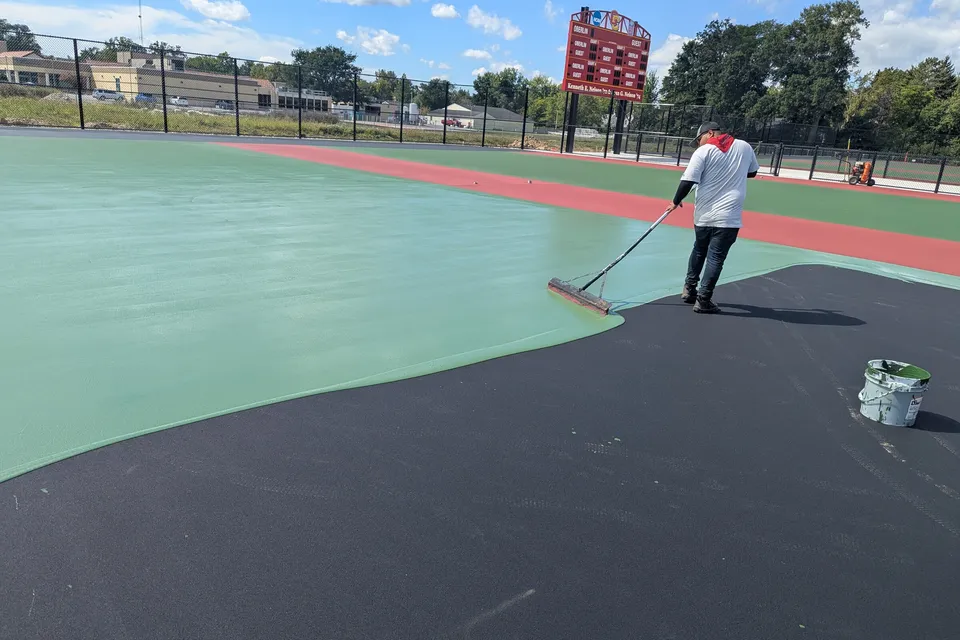
SkateMaster is SportMaster's acrylic coating for skating surfaces. Its data sheet describes a 100% acrylic emulsion system: 1 or 2 coats of Acrylic Resurfacer to fill and smooth the pavement, then 2 coats of SkateMaster on top. SkateMaster comes ready to use and is not diluted. The sheet puts it on any asphalt or concrete pavement where in-line hockey or roller sports are wanted, and adds that it can be used as "a durable surface for multi-purpose sport areas." Those are SportMaster's words, not ours.
What sets it apart from a tennis or pickleball court is the top of the system. On a court played on foot, the ColorPlus color coating system goes over the resurfacer. Where wheels are the point, SportMaster's guide specifications for roller hockey and skateboard surfaces name SkateMaster as the skate surface, to be applied without dilution and without added sand, over a last coat of resurfacer made with fine sand, 70 mesh or finer, which they say provides the texture for the skate surface's underlayment. SportMaster's maintenance manual draws the same line from the other side: among the rules it suggests posting at a court is no bikes, roller blades or skateboards, unless the surface is SkateMaster.
SkateMaster is the system SportMaster makes for this work, and we are a factory-authorized SportMaster installer. The work is the same trade as a court underneath: a sound, true slab, cracks and low spots repaired flush, coats squeegeed on one at a time in warm, dry weather, and the patience to let each one dry. How a job runs here is below, with SportMaster's figures beside it. Skating surfaces are on our project list beside the courts: we resurfaced the City of Ravenna's skate park (the project).
What goes down
The system, from the pavement up.
Each layer is a SportMaster product with a data sheet of its own. The name opens it.
| Layer | Coats | What it does |
|---|---|---|
| Acrylic Adhesion Promoter (on concrete) | Thin coat, 200 to 300 square feet per gallon | A clear-drying acrylic primer, applied by roller, spray or broom over the whole slab after the concrete has been roughened, acid etched, rinsed and dried, so the coats above it bond. The concrete guide specification asks for it over the entire surface. |
| Acrylic Resurfacer | 1 or 2 coats | Sand-filled acrylic, mixed on site, that fills the voids in the pavement and gives the skate coats a smooth, even underlayment; the number of coats depends on the pavement's porosity. SportMaster's engineering specification recommends at least 2 coats on new asphalt and a final coat with fine sand once the voids are filled; its asphalt guide specification writes 2 coats with 50-60 mesh sand on new or heavily repaired surfaces, then 1 with 70 mesh or finer. |
| SkateMaster | 2 coats minimum | The skating surface and its color: an acrylic coating that comes neutral, ready to use, tinted with ColorPlus pigment and applied without dilution, each coat dry before the next. |
| Stripe-Rite primer and line paint | 1 coat of line paint minimum | Lines laid out to the rules the specification names and taped; the clear primer seals the tape edge against bleed-under, then the line paint, which the guide specifications list in blue, red, white or yellow. Ours are hand taped and hand painted. |
Where it belongs
What SportMaster's documents write it for, and what the slab has to be.
A skating surface that has worn, cracked or been patched
A skate park or skating surface on asphalt or concrete whose coating has worn through, whose cracks have opened, or that has been patched in places is the job. A skating surface has to be true, hard and tolerant of wheels, and SportMaster's sheets ask for every crack, depression and surface defect repaired, and every repair flush and smooth to the surface around it, before the first coat.
Roller and in-line hockey rinks
SportMaster writes an engineering specification for in-line hockey, guide specifications for roller hockey and skateboard surfaces over asphalt and over concrete, and an in-line hockey rink diagram. Those uses are SportMaster's, and the lines follow the rules its documents name: USA Hockey InLine (USARS) in the guide specifications, the National In-Line Hockey Association guidelines in the engineering specification.
A multi-use slab that takes wheels
SportMaster's data sheet offers SkateMaster as a surface for multi-purpose sport areas, and allows sand to be added for texture on a multipurpose court. Where a slab is skated as well as played on, the choice between SkateMaster and the color coating system is one we talk through on the site walk, with the people who use it.
Wheels and the other SportMaster systems
SportMaster's maintenance manual suggests a court rule keeping bikes, roller blades and skateboards off unless the surface is SkateMaster. For a cushioned court, SportMaster's ProCushion maintenance sheet asks for bicycles, skateboards and scooters to be kept off the softer cushioned surface (ProCushion).
A sound base first
A coating does not fix a slab that has failed. SportMaster's specification says its color coating systems are designed for properly built sport surfaces, and points to the American Sports Builders Association for how to build them. A slab that heaves every winter or holds water is repaired or rebuilt first; the options, from filling to a rebuild, are on our crack repair page.
How the job runs
The work, in order.
-
01
The site walk
We walk the surface, check the plane, map the cracks and look at where the water sits, as on any job (how we work). SportMaster's guide specifications ask for the surface to be examined first and for no work to start until conditions that would hurt the coating are corrected. If the slab is not sound we say so.
-
02
Washing
The whole surface is pressure washed. SportMaster's guide specifications ask for dirt, dust, debris, oil, grease, vegetation and loose material to come off, and on concrete also sealers, curing compounds and loose coatings.
-
03
Cracks
SportMaster's engineering specification asks for every crack to be filled with Crack Magic, Acrylic Crack Patch, Acrylic Patch Binder or another suitable crack filler, and every repair to finish flush and smooth. How we decide which crack gets filled and which gets more is on our crack repair page; the SportMaster fillers and patch binder are on a page of their own.
-
04
Low spots
Depressions of 1/8 inch and deeper are leveled with Acrylic Patch Binder, as the specifications ask, so water does not stand on the finished surface and the wheels run on a true plane.
-
05
Concrete preparation
On concrete, SportMaster's concrete guide specification asks for a vapor barrier beneath the slab, perimeter drainage and no curing compounds on the surface. New concrete cures 28 days, has a medium broom finish or similar roughened texture and is never steel troweled, then is acid etched and rinsed; smooth existing concrete is sandblasted, shotblasted or scarified to a broom-like texture. Acrylic Adhesion Promoter goes over the whole slab.
-
06
Acrylic Resurfacer
The resurfacer goes on with a 50-60 durometer soft rubber squeegee, as the guide specifications ask: 1 or 2 coats by the data sheet, depending on how porous the pavement is, with the last coat made with 70 mesh sand or finer to give the skate coats their underlayment. On concrete, the concrete guide specification asks for 1 coat over new concrete or a surface with few repairs and 2 where the repairs are extensive.
-
07
SkateMaster coats
At least 2 coats of SkateMaster, tinted to the chosen color, squeegeed on with the same soft rubber squeegee and not diluted, each dry before the next.
-
08
Lines
Where a surface carries lines, they are laid out to the rules SportMaster's documents name, taped, sealed with Stripe-Rite and painted by hand.
-
09
Weather and cure
Every coat needs surface and air above 50 °F during application and for 24 hours after, and no rain expected in that time, so the job is planned inside our May to mid October season. SportMaster's data sheet asks for the coating to dry 48 hours before use, and its guide specifications allow a minimum of 48 hours before a roller hockey or skateboard surface opens.
The numbers
What SportMaster's sheets say.
Taken from the maker's own documents and checked against them each time this site is built. The sheet named beside each figure is the authority; open it before you write a specification.
| What | The sheet says | Which sheet |
|---|---|---|
| The system (data sheet) | 1 or 2 coats Acrylic Resurfacer, then 2 coats SkateMaster | SkateMaster Coating System technical data sheet |
| What it is | 100% acrylic emulsion system | SkateMaster Coating System technical data sheet |
| Dilution | None: ready to use | SkateMaster Coating System technical data sheet |
| Sand in SkateMaster (data sheet) | Up to 7 lbs per gallon, 80-100 mesh, only for texture on a multipurpose court | SkateMaster Coating System technical data sheet |
| SkateMaster coverage | .06 to .08 gallon per square yard per coat, ready to use | SkateMaster Coating System technical data sheet |
| Acrylic Resurfacer coverage | .07 to .09 gallon per square yard per coat | SkateMaster Coating System technical data sheet |
| Resurfacer sand (guide specification, materials) | 14 lbs silica sand per gallon, 70 mesh or finer | Roller hockey and skateboard: color coating system, over asphalt guide specification |
| Resurfacer coats on new or heavily repaired asphalt (guide specification) | 2 coats with 50-60 mesh sand, then 1 coat with 70 mesh or finer | Roller hockey and skateboard: color coating system, over asphalt guide specification |
| Air and surface temperature | Above 50 °F, during and for at least 24 hours after | SkateMaster Coating System technical data sheet |
| Before use | 48 hours of drying | SkateMaster Coating System technical data sheet |
| New asphalt cure before coating | 14 to 30 days | SkateMaster Coating System technical data sheet |
| New concrete | Cured 28 days, medium broom finish, acid etched | SkateMaster Coating System technical data sheet |
| Low spots leveled first | 1/8 inch and deeper | Roller hockey and skateboard: color coating system, over asphalt guide specification |
| Color | Neutral, tinted with ColorPlus Pigment Dispersion | SkateMaster Coating System technical data sheet |
The sheets
SportMaster's documents for this system.
The maker's own data sheets, safety data sheets, specifications and procedures, kept in our documents library so they are at hand for an owner, an architect or a crew. Each opens on a page that shows the document and offers the file.
Data sheets
SkateMaster, the pigment that tints it, and the primer, resurfacer and line products its documents put with it.
Data sheets for the repairs
The crack fillers and patch binder SportMaster's in-line hockey specification names.
Fichas técnicas (Spanish)
Safety data sheets
SkateMaster Neutral first; the SkateMaster Gray and Ice Blue sheets are older ones, as their titles say. Then Neutral Acrylic Resurfacer, Acrylic Adhesion Promoter, Stripe-Rite and White Line Paint.
Engineering specification
The SkateMaster system for in-line hockey.
Guide specifications
Editable specifications for an architect: roller hockey and skateboard surfaces, over asphalt and over concrete.
Mixing procedures
For the Acrylic Resurfacer under it.
Rink diagram
Maintenance
Questions
Asked on the site walk.
Pages that go with this one:
- Court crack repair · The repair options, from filling a crack to a rebuild.
- ColorPlus color coating system · The SportMaster system for courts played on foot.
- SportMaster crack repair products · The fillers and patch binder the specification names.
- Specifications · SportMaster's engineering and guide specifications for writing a bid.
- Multi-sport courts · One pad, more than one game.
- Ravenna skate park · The City of Ravenna's skate park, resurfaced.
- Basketball courts · Park and school courts built, resurfaced and lined.
The other SportMaster pages:
Can a skate park be resurfaced, or does it have to be rebuilt?
Often it can be resurfaced, if the slab under it is sound. SportMaster's guide specifications put the resurfacer over asphalt, over concrete and over previously colored acrylic surfaces, once the cracks and low spots are repaired and made flush. A slab that has failed, heaves every winter or holds water needs repair or rebuilding first; our crack repair page sets out the options from filling to a rebuild. SportMaster's documents write SkateMaster for pavement and do not speak to ramps, bowls or other formed features, so neither does this page.
How is it different from a tennis court surface?
The resurfacer under it is the same product; the top is not. A tennis or pickleball court gets the ColorPlus color coating system; a skating surface gets at least 2 coats of SkateMaster, applied without dilution and, by the guide specifications, without added sand, over a last coat of resurfacer made with fine sand. SportMaster's maintenance manual suggests keeping bikes, roller blades and skateboards off its court surfaces unless the surface is SkateMaster.
Can it go on concrete?
Yes, SportMaster writes it for asphalt and for concrete. New concrete cures 28 days and needs a medium broom finish or similar roughened texture, an acid etch and Acrylic Adhesion Promoter before the resurfacer; smooth existing concrete is blasted or scarified to a rougher texture first. The concrete guide specification also asks for a vapor barrier beneath the slab and perimeter drainage so moisture does not collect under it.
How long before it can be skated on?
SportMaster's data sheet asks for the coating to dry 48 hours before use, and its guide specifications allow a minimum of 48 hours before a roller hockey or skateboard surface opens. That clock starts after the last coat, and every coat before it needs surface and air above 50 °F for 24 hours and no rain, so the weather sets the calendar more than the crew does.
Can bikes and scooters use it?
SportMaster's documents do not answer that directly. Its maintenance manual suggests a court rule of "No bikes, roller blades, or skateboards (Unless using SkateMaster Surfacing System)", and the SkateMaster sheets write the system for in-line hockey, roller sports and roller hockey and skateboard surfaces. Scooters are not named in them, and we do not go further than the sheets.
Who installs SkateMaster near Cleveland?
Industrial Surface, in Cleveland, is a factory-authorized SportMaster installer and resurfaces skate parks and skating surfaces in Northeast Ohio. SportMaster's letter naming us an authorized installer goes in the bid file, with the rest of our credentials.
Free estimates
A SportMaster court, from the installer down the road.
Send the address and what you have in mind. We walk the site, measure it, and send a written proposal that names the system, the coats and the season it fits.
The yard
4000 East 86th Street, Cleveland, OH 44105
Off Broadway Avenue, south of downtown, ten minutes from I-77 and I-490.
Serving Cuyahoga, Summit, Lake, Lorain, Medina, Geauga, Portage, Stark and Ashtabula counties. Municipal, school, club, HOA and commercial work; residential courts by the job.