


SportMaster authorized installer · Northeast Ohio
Resurfacer, color, lines: the SportMaster system on our courts.
Tennis, pickleball and basketball courts across Northeast Ohio get the same surface from us: SportMaster Acrylic Resurfacer, ColorPlus color coats with silica sand in them, and lines taped and painted by hand. Here is what goes down, in what order, and what SportMaster's own sheets ask for at each step.
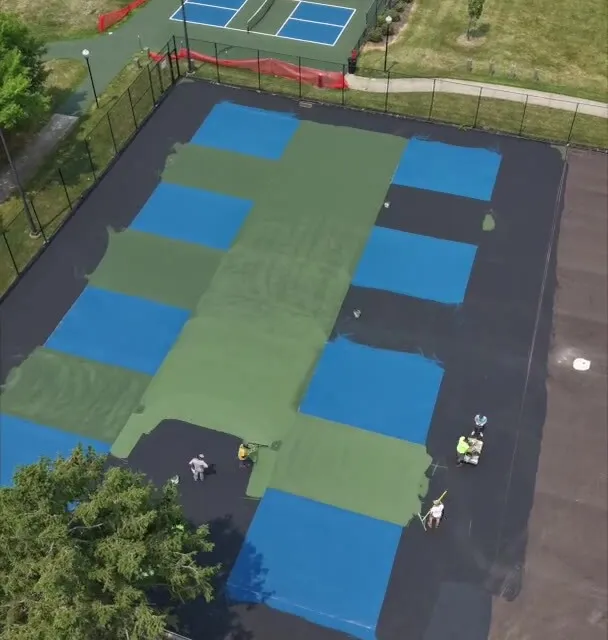
The court work we do comes down to one system: SportMaster's acrylic color coating, squeegeed onto asphalt or concrete in layers. Acrylic Resurfacer goes on first to fill the pavement's texture, then the color coats with silica sand in them, then the lines. It is the surface on every court in the photographs on this site, from a single backyard court to the Parma Heights rebuild.
Why coat a court at all? So it plays the same from corner to corner. The resurfacer fills the pores and roughness of the pavement so the color goes on even and full depth, and on an old court it gives a worn, smooth surface its tooth back. The color coats carry the sand, and SportMaster's own guidance is that the size and shape of that sand are very important to how the court looks and how fast it plays. The lines go on last, over a court that is one color and one texture.
SportMaster is made by ThorWorks in Sandusky, an hour west of our yard. We are one of its authorized installers and a member of the American Sports Builders Association, and we have been building and resurfacing courts in Northeast Ohio since 1957. The color we use is ColorPlus: a SportMaster neutral base such as Neutral Concentrate, tinted on site with ColorPlus pigment. SportMaster also makes the same kind of coating in premixed colors (Color Concentrate and Ready-Mix Color) and a more heavily pigmented ColorPlus Pro; the sheets for all of them are in the documents below.
What goes down
The system, from the pavement up.
Each layer is a SportMaster product with a data sheet of its own. The name opens it.
| Layer | Coats | What it does |
|---|---|---|
| Acrylic Adhesion Promoter (on concrete) | Thin coat, after the acid etch | A clear-drying acrylic primer. New or uncoated concrete is etched with phosphoric or muriatic acid, rinsed, dried completely, and primed, so the resurfacer and the color hold to it. |
| Acrylic Resurfacer | 1 or 2 coats | Acrylic resurfacer mixed on site with silica sand and water and squeegeed on to fill the texture and porosity of the pavement, so the color goes on even. 1 coat over a sound old surface, 2 on new asphalt or after heavy crack and low-spot repair. |
| ColorPlus color coats | 2 coats minimum | Neutral Concentrate tinted on site with ColorPlus pigment and filled with silica sand, or Neutral Concentrate with Sand, which arrives with the sand in it. The sand is the court's texture and sets its pace. Each coat dries before the next. |
| Stripe-Rite line primer | Over the taped lines | A clear-drying acrylic primer put on over the masking tape before the paint. It seals the gap between the tape and the textured surface so the line paint does not bleed under and the edges stay sharp. |
| White Line Paint or Textured White Line Paint | 1 coat minimum | Acrylic line paint, rolled or brushed between the tapes. The textured version has fine sand in it so a line has a texture like the rest of the court. Every line is hand taped and hand painted. |
When we recommend it
The court it suits.
A worn court due for resurfacing
Color worn through to the black, the sand texture gone, cracks that have opened again, water that stands after rain. The court is washed, repaired and leveled, then gets 1 coat of resurfacer if the old surface is sound, or 2 where there has been heavy crack and low-spot repair, the way SportMaster's guide specifications divide it, then color and lines. The tennis resurfacing page lists the signs.
A new asphalt court, once it has cured
SportMaster's specification has new asphalt cure 14 to 30 days before any coating, and its best-practices guide recommends the full 30 days. New asphalt gets 2 coats of resurfacer before the color. We build the base and pave as well, so the cure is in the schedule from the first day; see tennis court construction.
A concrete court
The same system, with an acid etch and a coat of Acrylic Adhesion Promoter first on new or uncoated concrete. SportMaster's concrete specification wants the slab cured 28 days and built for a coating: a vapor barrier under it, drainage around it, a broom finish and no curing compound.
A tennis court gaining pickleball lines
When a tennis court is resurfaced, pickleball lines can go on at the same time in a second color, so one court serves both games. See multi-sport courts and pickleball court resurfacing.
Where cushion is wanted
Where the owner wants cushion underfoot, SportMaster's ProCushion system puts cushion layers between the resurfacer and the color coats. The site walk is where we work out what a court should have.
How the job runs
The work, in order.
-
01
The site walk
We walk the court with you, map the cracks, check the plane with a level and see where water stands. On concrete, SportMaster's guide specification adds the slab itself to the examination: a vapor barrier, perimeter drainage, no curing compound. Tell us if a parking-lot sealer was ever put on the court, because SportMaster's guidance is that acrylics do not bond well to coal tar or most asphalt-based sealers. The process page has the whole job from the first call.
-
02
Washing
The whole court is pressure washed down to sound surface, as SportMaster's guide specifications ask, and algae is treated where the court sits in shade. Dirt, chalking color and anything loose come off so the new coats bond to something that will hold them.
-
03
Crack repair
Cracks are repaired before any coating goes on, with a fabric-membrane system on the courts we repair (see our crack repair page); the fillers and the patch binder are SportMaster's. SportMaster's specification asks that every crack be filled and every repair be flush and smooth with the court around it.
-
04
Leveling
Low spots are flooded, marked and filled with acrylic patch binder, feathered to the plane. SportMaster's specification levels any birdbath 1/8 inch deep or more.
-
05
Concrete only: roughen, etch, prime
SportMaster's concrete guide specifications have a smooth existing slab roughened first, by shot blasting, sandblasting or scarifying, to the texture of a medium broom finish. New or uncoated concrete is then etched with phosphoric or muriatic acid, rinsed, left to dry completely, and primed with Acrylic Adhesion Promoter.
-
06
Acrylic Resurfacer
1 or 2 coats, pulled with soft rubber squeegees, successive coats in cross directions, rough spots and ridges scraped off between coats. SportMaster's sheets give a coat 30 to 60 minutes to dry in good drying weather; cold and humidity stretch that.
-
07
Color
2 coats of ColorPlus with sand, squeegeed, each one dry before the next. SportMaster's sheets want the air and the surface above 50 °F while the coat goes on and for 24 hours after, with no rain in that time. The season page has the months when Northeast Ohio gives us that.
-
08
Lines
Laid out by hand to the USTA, USA Pickleball or basketball diagram, hand taped, sealed with Stripe-Rite primer as the specification asks, and hand painted in textured line paint, two coats on our courts against SportMaster's minimum of one.
-
09
Cure, then play
SportMaster's guide specifications for tennis, pickleball and basketball allow play after a minimum of 24 hours of curing; its Neutral Concentrate sheet asks for 48 hours. Nets go back up, the court is swept, and you get a maintenance sheet.
The numbers
What SportMaster's sheets say.
Taken from the maker's own documents and checked against them each time this site is built. The sheet named beside each figure is the authority; open it before you write a specification.
| What | The sheet says | Which sheet |
|---|---|---|
| Air and surface temperature | Above 50 °F while coating and for at least 24 hours after | Neutral Concentrate technical data sheet |
| Drying time per coat | 30 to 60 minutes in good drying weather; longer when cool or humid | Neutral Concentrate technical data sheet |
| Before play (Neutral Concentrate data sheet) | 48 hours of cure | Neutral Concentrate technical data sheet |
| Before play (tennis guide specification) | 24 hours of cure at least | Tennis: color coating system, over asphalt guide specification |
| New asphalt before coating | 14 to 30 days of cure | Color coating systems over asphalt engineering specification |
| New concrete before coating | 28 days of cure | Color coating systems over concrete engineering specification |
| Concrete surface | Medium broom or similar roughened texture, never steel troweled; CSP 3 or 4 recommended if shot blasted | Color coating systems over concrete engineering specification |
| Concrete slab | Vapor barrier beneath, perimeter drainage, no curing compounds | Color coating systems over concrete engineering specification |
| Low spots to level | 1/8 inch deep or more | Color coating systems over asphalt engineering specification |
| Acrylic Resurfacer coverage | .07 to .09 gallon per square yard per coat, undiluted | Acrylic Resurfacer technical data sheet |
| Color coat coverage (Neutral Concentrate) | .05 to .07 gallon per square yard per coat, undiluted | Neutral Concentrate technical data sheet |
| Line paint coverage | 500 to 600 feet of 2-inch line per gallon | White Line Paint technical data sheet |
| Not over | A pavement sealer: coal tar or most asphalt-based sealers | 10 best practices of repairing and resurfacing tennis and basketball courts |
| Resurfacing cycle | 5 to 8 years, SportMaster's standard | Sport surfaces maintenance manual, 2024 |
Local work
Where you can go and see it.
-
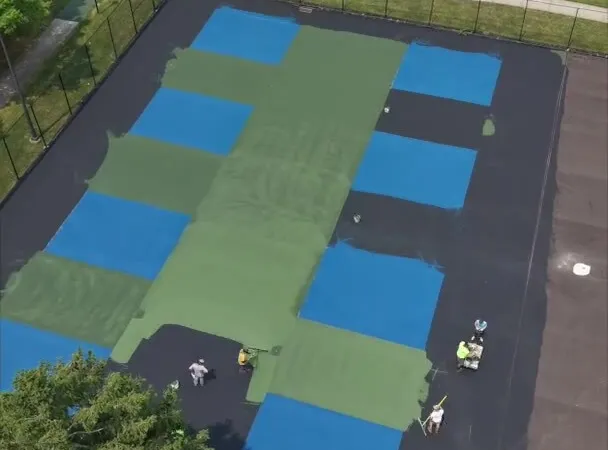
Multi-sport · Rebuild and resurfacing
Parma Heights: three tennis and seven pickleball courts at Greenbrier Commons
A city's whole court complex rebuilt in one season, bought through the SportMaster cooperative contract without a separate bid. The biggest job on the public record.
-
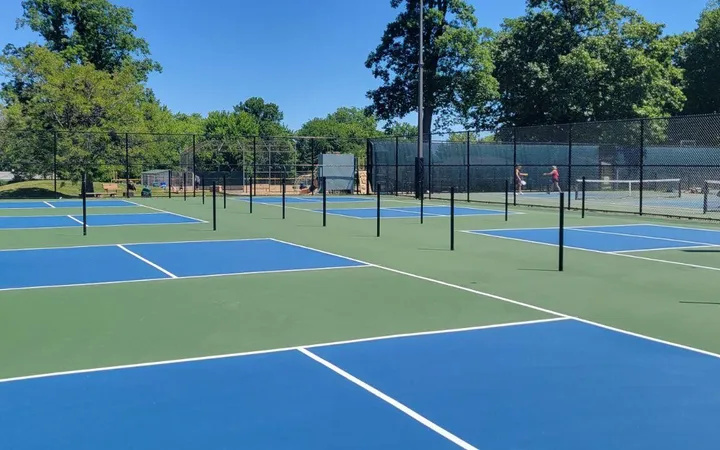
Pickleball · Conversion
Bay Village: a basketball court becomes four pickleball courts at Reese Park
The city asked for pickleball without building a new pad. Four courts, a cross of fence between them, done for the price of a used car.
-
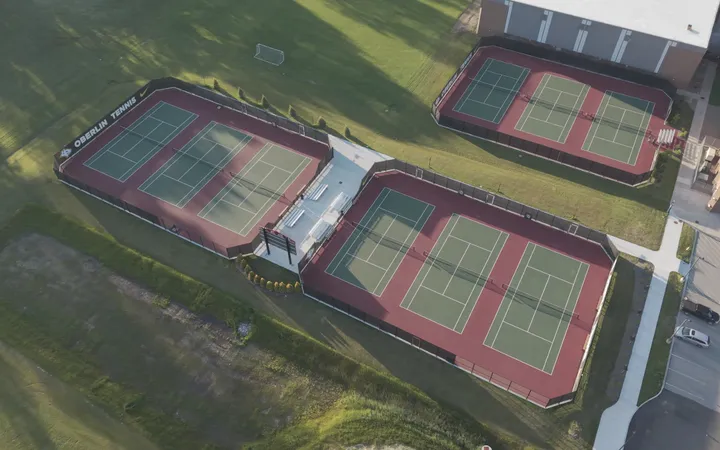
Tennis · Court surfacing
Oberlin College: the new tennis complex, nine courts in maroon and green
A college bank of courts in the school's colors, its name on the windscreens.
The sheets
SportMaster's documents for this system.
The maker's own data sheets, safety data sheets, specifications and procedures, kept in our documents library so they are at hand for an owner, an architect or a crew. Each opens on a page that shows the document and offers the file.
Data sheets
The resurfacers, the color coatings, the concrete primer and the line products.
- Acrylic Resurfacer · technical data sheet
- Acrylic Resurfacer with Sand · technical data sheet
- Neutral Concentrate · technical data sheet
- Neutral Concentrate with Sand · technical data sheet
- ColorPlus Pigment Dispersion · technical data sheet
- ColorPlus Pro System · technical data sheet
- Color Concentrate · technical data sheet
- Color Concentrate with Sand · technical data sheet
- Ready-Mix Color · technical data sheet
- Acrylic Adhesion Promoter · technical data sheet
- Stripe-Rite · technical data sheet
- White Line Paint · technical data sheet
- Textured White Line Paint · technical data sheet
- Black Dispersion · technical data sheet
- Neutral Ready Mix · technical data sheet
- Acrylic Patch Binder · technical data sheet
Data sheets in Spanish
SportMaster's fichas técnicas for the same products, where it publishes one.
- Acrylic Resurfacer (Spanish) · technical data sheet
- Acrylic Resurfacer with Sand (Spanish) · technical data sheet
- Neutral Concentrate (Spanish) · technical data sheet
- Neutral Concentrate with Sand (Spanish) · technical data sheet
- ColorPlus Pigment Dispersion (Spanish) · technical data sheet
- ColorPlus Pro System (Spanish) · technical data sheet
- Color Concentrate with Sand (Spanish) · technical data sheet
- Ready-Mix Color (Spanish) · technical data sheet
- Acrylic Adhesion Promoter (Spanish) · technical data sheet
- Stripe-Rite (Spanish) · technical data sheet
- White Line Paint (Spanish) · technical data sheet
- Textured White Line Paint (Spanish) · technical data sheet
Safety data sheets: resurfacers, primer and line products
- Acrylic Resurfacer (black) · safety data sheet
- Neutral Acrylic Resurfacer · safety data sheet
- Acrylic Resurfacer with Sand (black) · safety data sheet
- Neutral Acrylic Resurfacer with Sand · safety data sheet
- Acrylic Adhesion Promoter · safety data sheet
- Stripe-Rite · safety data sheet
- White Line Paint · safety data sheet
- Textured White Line Paint · safety data sheet
Safety data sheets: Neutral Concentrate and ColorPlus pigments
One sheet for each ColorPlus pigment, and the neutral bases.
- Neutral Concentrate · safety data sheet
- Neutral Concentrate with Sand · safety data sheet
- ColorPlus Pigment Dispersion, Beige · safety data sheet
- ColorPlus Pigment Dispersion, Blue · safety data sheet
- ColorPlus Pigment Dispersion, Brite Red · safety data sheet
- ColorPlus Pigment Dispersion, Brown · safety data sheet
- ColorPlus Pigment Dispersion, Dark Green · safety data sheet
- ColorPlus Pigment Dispersion, Dove Gray · safety data sheet
- ColorPlus Pigment Dispersion, Forest Green · safety data sheet
- ColorPlus Pigment Dispersion, Gray · safety data sheet
- ColorPlus Pigment Dispersion, Ice Blue · safety data sheet
- ColorPlus Pigment Dispersion, Light Blue · safety data sheet
- ColorPlus Pigment Dispersion, Light Green · safety data sheet
- ColorPlus Pigment Dispersion, Maroon · safety data sheet
- ColorPlus Pigment Dispersion, Orange · safety data sheet
- ColorPlus Pigment Dispersion, Red · safety data sheet
- ColorPlus Pigment Dispersion, Sandstone · safety data sheet
- ColorPlus Pigment Dispersion, Tournament Purple · safety data sheet
- ColorPlus Pigment Dispersion, Yellow · safety data sheet
- Black Dispersion · safety data sheet
- Neutral Ready-Mix · safety data sheet
Safety data sheets: premixed colors
Color Concentrate, Color Concentrate with Sand and Ready-Mix Color, one sheet per color.
- Color Concentrate, Beige · safety data sheet
- Color Concentrate, Blue · safety data sheet
- Color Concentrate, Brown · safety data sheet
- Color Concentrate, Forest Green · safety data sheet
- Color Concentrate, Gray · safety data sheet
- Color Concentrate, Light Green · safety data sheet
- Color Concentrate, Maroon · safety data sheet
- Color Concentrate, Red · safety data sheet
- Color Concentrate, Dark Green · safety data sheet
- Color Concentrate with Sand, Beige · safety data sheet
- Color Concentrate with Sand, Blue · safety data sheet
- Color Concentrate with Sand, Brown · safety data sheet
- Color Concentrate with Sand, Forest Green · safety data sheet
- Color Concentrate with Sand, Gray · safety data sheet
- Color Concentrate with Sand, Light Green · safety data sheet
- Color Concentrate with Sand, Maroon · safety data sheet
- Color Concentrate with Sand, Red · safety data sheet
- Color Concentrate with Sand, Dark Green · safety data sheet
- Ready-Mix Color, Beige · safety data sheet
- Ready-Mix Color, Blue · safety data sheet
- Ready-Mix Color, Brown · safety data sheet
- Ready-Mix Color, Forest Green · safety data sheet
- Ready-Mix Color, Gray · safety data sheet
- Ready-Mix Color, Light Green · safety data sheet
- Ready-Mix Color, Maroon · safety data sheet
- Ready-Mix Color, Red · safety data sheet
- Ready-Mix Color, Dark Green · safety data sheet
Engineering specifications
The system over asphalt and over concrete.
Guide specifications
Editable specification sections for an architect: tennis over asphalt and over concrete, pickleball over concrete, and basketball and recreational courts over asphalt and over concrete.
- Tennis: color coating system, over asphalt · guide specification
- Tennis: color coating system, over concrete · guide specification
- Pickleball: color coating system, over concrete · guide specification
- Basketball and recreational courts: color coating system, over asphalt · guide specification
- Basketball and recreational courts: color coating system, over concrete · guide specification
Mixing procedures
SportMaster's mixing charts, by keg and by drum.
- Acrylic Resurfacer, 30-gallon keg · mixing procedure
- Acrylic Resurfacer, 55-gallon drum · mixing procedure
- ColorPlus System, 30-gallon keg · mixing procedure
- ColorPlus System, 55-gallon drum · mixing procedure
- ColorPlus System with Sand, 30-gallon keg · mixing procedure
- ColorPlus System with Sand, 55-gallon drum · mixing procedure
- Color Concentrate, 30-gallon keg · mixing procedure
- Color Concentrate, 55-gallon drum · mixing procedure
- Color Concentrate with Sand, 30-gallon keg · mixing procedure
- Color Concentrate with Sand, 55-gallon drum · mixing procedure
Care, practice and color
The maintenance manual, SportMaster's best practices and tool list for repairing and resurfacing, its answers on streaking and cracked lines, the court diagrams, and the color cards.
- Sport surfaces maintenance manual, 2024 · guide
- 10 best practices of repairing and resurfacing tennis and basketball courts · guide
- Color chip brochure · color card
- ColorPlus Fusion System handout · color card
- Tennis court surfacing and repair: recommended tools and equipment · guide
- What causes streaking on a tennis court surface? · guide
- Why do the white lines crack on a tennis court? · guide
- Tennis court layout, striping and slope · court diagram
- Pickleball court diagram · court diagram
- Basketball court diagram · court diagram
Questions
Asked on the site walk.
Pages that go with this one:
- Tennis court resurfacing · The signs a court is due, and what the job includes.
- Pickleball court resurfacing · The same system on courts built for pickleball.
- Basketball court resurfacing · Park and school courts, keys and arcs to the rulebook.
- Crack repair · The fabric-membrane repair that goes in before the coating.
- Court colors · The ColorPlus range and the pairings we recommend.
- How a project goes · From the first call to the handover.
The other SportMaster pages:
How long before we can play on it?
SportMaster's guide specifications for tennis, pickleball and basketball allow play after a minimum of 24 hours of curing; its Neutral Concentrate data sheet, the base of ColorPlus, asks for 48 hours. Cool or humid days slow every coat, so the weather has the last word on the date. The process page shows the order of the work.
How many coats go on?
From the pavement up: 1 or 2 coats of Acrylic Resurfacer, at least 2 color coats, then the lines. SportMaster's guide specifications ask for 2 coats of resurfacer on new asphalt and on old courts with heavy crack and low-spot repair, and 1 on an old surface in good condition. Our practice is 2 coats of ColorPlus on every court.
Can it go over concrete?
Yes. SportMaster's concrete specification wants the slab cured 28 days, with a medium broom finish and never steel troweled, a vapor barrier under it, perimeter drainage and no curing compound. New or uncoated concrete is etched with acid, rinsed, dried and primed with Acrylic Adhesion Promoter before the resurfacer and the color. A slab built without the vapor barrier or the drainage is something to settle before any coating goes on.
What colors can we have?
Any of the ColorPlus colors, and the usual court here is two of them: a darker color inside the lines and a lighter one outside. The court colors page has the range, the pairings we recommend and what color does to heat and glare.
How is it maintained, and how long does it last?
Keep it clean, get standing water and leaves off it, and keep metal chair legs, bikes, salt and plow blades away from it. SportMaster's maintenance manual suggests a cleaning once a month and an inspection every spring, and gives 5 to 8 years as the standard resurfacing cycle. Our maintenance calendar has the month-by-month care, and our coatings carry a two-year limited warranty.
Can a city or a school buy it without a bid?
A member of the Equalis Group cooperative can. We are SportMaster's authorized installer under Equalis Group contract COG-2138B, so a member city, school or agency can buy court work at the contract's rates without running its own bid; Parma Heights bought its court rebuild that way. SportMaster's letter naming us an authorized installer goes in the bid file.
Free estimates
A SportMaster court, from the installer down the road.
Send the address and what you have in mind. We walk the site, measure it, and send a written proposal that names the system, the coats and the season it fits.
The yard
4000 East 86th Street, Cleveland, OH 44105
Off Broadway Avenue, south of downtown, ten minutes from I-77 and I-490.
Serving Cuyahoga, Summit, Lake, Lorain, Medina, Geauga, Portage, Stark and Ashtabula counties. Municipal, school, club, HOA and commercial work; residential courts by the job.